
Chinese New Year's Eve
除夕 · Chú Xī
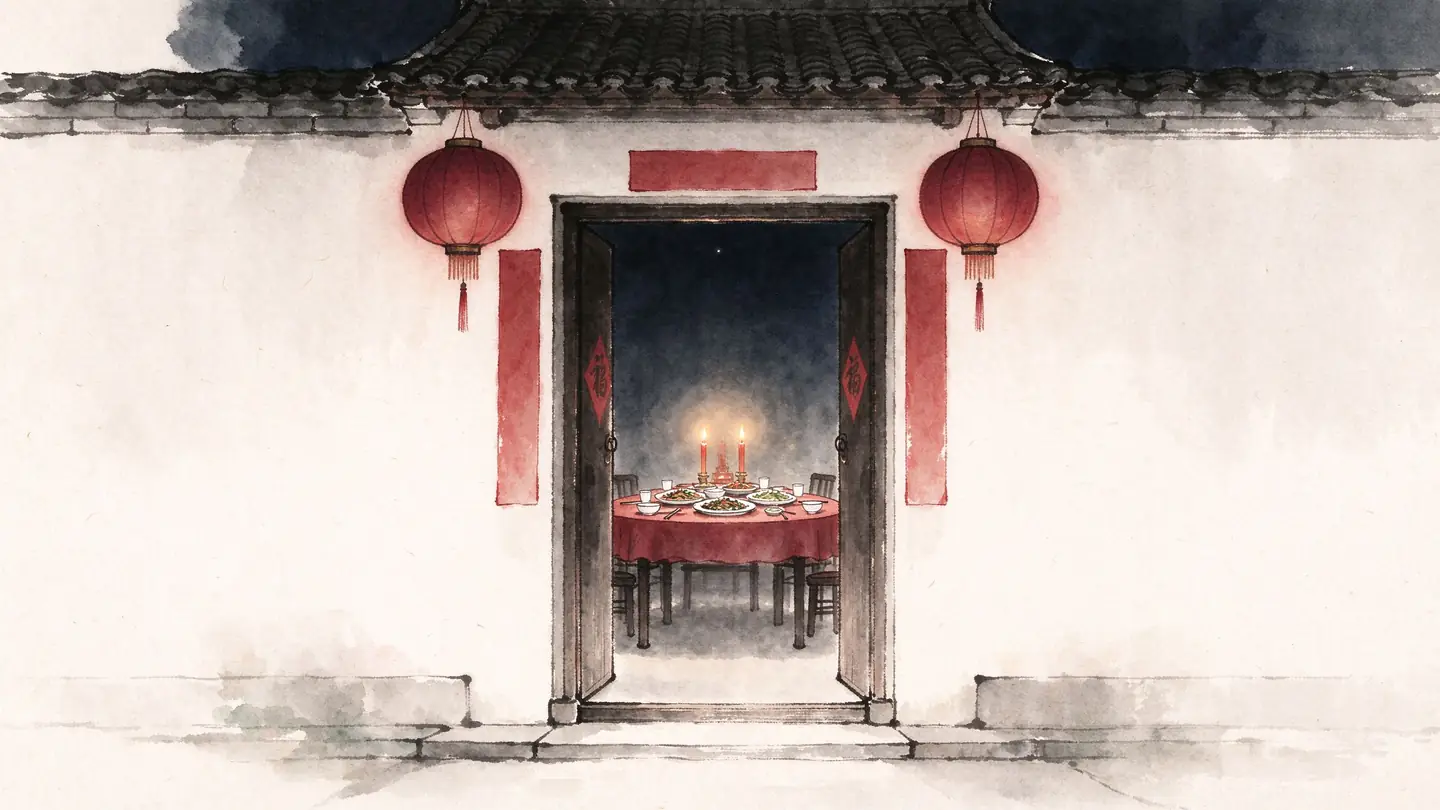
The story behind it Origin & legend
Chinese New Year's Eve is the last day of the twelfth lunar month and the hinge of the whole festival season. Its central ritual is the reunion dinner, followed by 守岁 — staying up together to see the old year out and the new year in. The name 除夕 means roughly 'the night the old year is removed': the first character is to root out or take away, the second is the evening.
It is the last day of the lunar year, which is not always the thirtieth. When the twelfth month has only twenty-nine days, New Year's Eve falls on the twenty-ninth, and the countdown runs a day short. People still say 'the thirtieth' out of habit, but the date follows the lunar calendar, not a fixed number.
The custom of staying up all night, 守岁, is recorded at least as far back as the Jin dynasty, when families kept lamps and fires burning to greet the new year. The idea behind it is double: that light and wakefulness drive off bad influence, and that seeing the year in together is itself a way of holding the family together. The folk tale told for the night gives the same protective devices a name — red paper, fire, noise and staying awake.
Today the shape has changed. Firecrackers are banned or restricted in most big cities, greetings move through phones at midnight, and the reunion dinner is often booked in a restaurant instead of cooked at home. What has held firm is the sequence — the meal, the staying up, the crossing of midnight — which most families still keep in some form.
What it means Cultural significance
- The reunion dinner is the whole point
- The year's most important meal gathers the family at one table. Who is present matters far more than what is served, and an empty chair is sometimes left for someone who could not come home.
- 守岁: the family crosses midnight awake
- Staying up until the year turns is the festival's signature act. It marks the boundary between the years consciously rather than sleeping through it, and the older generation once saw long life in the children's late night.
- A protected threshold between years
- The old logic of the night is defensive: red paper, lights, noise and wakefulness together hold back bad luck at the moment of change. Even without the belief, the ritual of guarding the house through the turn survives.
- Settling the year before it closes
- Debts, quarrels and unfinished business are traditionally squared away before the meal. New Year's Eve is the deadline of the old year, so that the new one starts with nothing outstanding.
- The last night of the year, whatever its date
- The festival follows the lunar calendar, so its own date shifts: usually the thirtieth of the twelfth month, sometimes the twenty-ninth. The constant is the role — the final night — not the number of the day.
- Food that is chosen to mean something
- Nearly every dish at the table carries a pun or a wish — surplus, unity, long life. The menu is chosen to say things the family does not otherwise say out loud.
Hour by hour A day in the festival
- Morning · the last preparations
- The house is finished and the couplets go up. Old ones come down first, then fresh red paper is pasted on both sides of the door and the fortune sign on the door itself.
- Midday · inviting the ancestors home
- In many regions the ancestors are invited home for the meal, and in some places families visit the grave earlier in the day. A place is set, or an offering made, before anyone sits down.
- Afternoon · the kitchen's busiest hours
- The reunion dinner is cooked, or the family gathers at a booked restaurant. Cold dishes and braises are made ahead, since tradition says no knife should touch food the next day.
- Dusk · the reunion dinner
- The year's most important meal. Everyone who can be at the table is, and a member who is missing is often remembered with an empty place or a quiet word.
- Late evening · 守岁 and television
- The table is cleared and the family settles in to stay awake. The four-hour Spring Festival Gala runs on television, and cards, mahjong and phone greetings fill the hours until midnight.
- Midnight · the year turns
- Firecrackers where they are allowed, greetings down the family by seniority, red envelopes for children, and dumplings in the north. The first minutes of the new year are spent calling those who could not come.
What people do Customs & activities
- The reunion dinner (年夜饭)
- The main event, eaten at home or, increasingly, in a restaurant booked months ahead. Dishes are chosen for lucky names, and no one is expected to rush the meal.
- Pasting of couplets and the good-fortune sign (贴春联)
- Fresh red couplets go up on both sides of the door, with the character for fortune on the door or hung upside down — upside down because 'inverted' sounds like 'has arrived'.
- Offering to the ancestors (祭祖)
- Many families offer the ancestors food and paper money before the meal, and set a place or invite them in. In some regions the ancestors are collected from the family grave earlier the same day.
- Staying up to 守岁
- The household keeps the lights on and stays awake past midnight. Children are traditionally allowed to stay up, which is part of the treat, and the Spring Festival Gala on television fills the hours.
- Firecrackers and fireworks
- Banned or restricted in most large cities, but where they are allowed the noise at midnight is the traditional signal that the year has turned. Electronic crackers replace them where they are not.
- Handing out red envelopes (压岁钱)
- Elders give children red paper packets of money, usually after the reunion dinner or at midnight. The name means 'pressing down the year' — originally to suppress a harmful influence, now simply a gift.
- Dumplings and the late-night meal
- In the north, dumplings are often made together and eaten after midnight, their shape said to resemble old silver ingots. The making is as much social as the eating.
- Greeting the new year in order
- As midnight passes, greetings go down the family by seniority, grandparents first. In many homes the first moments of the new year are spent on the phone with those who are not at the table.
How it varies across China Regional differences
- North vs South: what is on the table
- The north serves dumplings late into the night, made together and shaped like silver ingots. The south leans on rice cake, glutinous dishes and eight-treasure rice. Each side considers its own the real New Year's food.
- Firecrackers, city by city
- Most large cities restrict or ban firecrackers for air quality, so the midnight noise now depends on where you are. Some districts allow them in fixed hours; the countryside is far louder than the city.
- The Eve, or the Eve's Eve
- In some regions the biggest meal is the 'little New Year's Eve' on the twenty-ninth, with the last day kept lighter; in others all the weight sits on the final night. Both customs are common and neither is standard for the whole country.
- How the night is spent
- Northern families often make and eat dumplings after midnight; southern families gamble, watch television or stay up over tea. Where firecrackers are banned, electronic crackers and screens fill the silence.
- Overseas: an earlier midnight
- Overseas Chinese communities often hold the reunion dinner on the nearest weekend, since the Eve itself is not a public holiday. Some watch the live broadcast from China at their own midnight, several hours off.
What to say — and what not to Greetings
- Say at 守岁: 新年快乐 or 新春快乐
- As midnight passes, the standard greeting is 'Happy New Year', or 'Happy New Spring'. Add the zodiac for warmth — 'great fortune in the Year of the Dragon'. Greet elders before anyone else, since greetings run down the family by seniority.
- Say to elders: 身体健康, not just 'happy'
- To parents and grandparents, the warmer and more respectful wish is 'good health', often paired with a wish that everything goes their way. Health comes before cheer for older relatives, and the phrasing shows you know the difference.
- Don't say: words for death, illness, broken or finished
- On the night and in the days after, the words 死 (death), 病 (illness), 破 (broken) and 完 (finished) are avoided, because the year's tone is thought to be set now. If a child says one, the ritual rescue line is 童言无忌 — 'children's words carry no weight'.
- On the red envelopes: give with both hands
- The money packet is handed over with both hands, and the amount is even, not odd. Recipients pass packets on to the children in the family; refusing one outright can embarrass the giver, so accept and thank them instead.
- If a family is in mourning: lower the tone
- In many regions a family that lost someone during the year does not exchange a cheerful 'happy New Year' or accept red envelopes. A quiet 'restrain your grief', or simply 'take care of yourself', is the respectful choice.
- If you are far from home: send it before midnight
- Midnight greetings overwhelm the networks, so send early or expect delays. A short line referencing the reunion is enough — 'thinking of you at the reunion table' — and for someone who lost family, keep it to health rather than cheer.
How to prepare Before the day
- Book the restaurant far ahead
- If the reunion meal is eaten out, good tables are booked weeks or months in advance and sell out well before New Year's Eve. Home cooking avoids the scramble but needs its own shopping done early.
- Buy and cook in advance
- The traditional rule is that no knife touches food on New Year's Day, so much of the Eve cooking is done ahead — cold dishes, braises, dumpling fillings — and simply reheated.
- Get new banknotes for red envelopes
- Banks run short of crisp notes in the last week, so get them early and decide your tiers: close family, distant relatives, colleagues' children. Digital red envelopes need no notes but need the same sorting.
- Put up the couplets at the right time
- Couplets and the fortune sign go up on the Eve, not days earlier, and the old ones come down first. Some families time it to the morning of the Eve, so the door is fresh for the new year.
- Lay in the lucky dishes
- Whole fish for surplus, chicken for wholeness, dumplings or rice cake, and a dish whose name puns on abundance. Order seafood and poultry early; fresh fish sells out on the day itself.
- Settle debts and old business
- The Eve is the classic deadline for paying what you owe and finishing unfinished work, so the new year starts clean. Doing it after midnight is considered too late.
- Charge the phones and expect the traffic
- Midnight greetings overload messaging apps every year. Send earlier or accept the delay, and make sure the family group is set up before the night, not during it.
What not to do Taboos
- Do not go to bed before the year turns
- Staying up past midnight is the festival's central custom; sleeping early is thought to let the new year arrive ungreeted. In the old rationale, the light and wakefulness also hold off bad luck.
- Do not sweep or throw out rubbish
- Sweeping, or taking the rubbish out on the night, is believed to sweep or throw out the family's fortune. Leave the floor and the bin until after New Year's Day.
- Do not break plates, glasses or mirrors
- A break at the turn of the year is read as a sign of loss. If it happens, the rescue phrase is a pun on 'broken' and 'year', meaning 'peace every year'.
- Do not say words for death, illness or breaking
- Words for death (死), illness (病), broken (破) and finished (完) are avoided on the night and just after, so the year is not set a bad tone. If a child says one, say 童言无忌, 'children's words carry no weight'.
- Do not cry, argue or scold
- A quarrel or tears at the turn of the year is believed to set the mood for the whole year. Parents traditionally hold back from scolding a child on this night, even when it is earned.
- Do not let the dumplings burst or collapse
- A burst dumpling in the pot is unlucky at New Year, so cooks are careful to seal them well. In the north, where they are made in large numbers, a split one is quietly put aside.
- Do not turn off all the lights
- Keeping a lamp on through the night is part of 守岁 and of guarding the house at the turn of the year. Total darkness runs against the custom.
- Do not forget the missing seat
- If a family member is absent, a place or a word is often left for them. Skipping it in a household that observes the custom is a quiet but real omission.