Mid-Autumn Festival
中秋节 · Zhōng Qiū Jié
The story behind it Origin & legend
Mid-Autumn began as a harvest festival and a night of moon worship, and it is at least 3,000 years old — it appears in the Shang dynasty as an autumn rite, was formalised in the Tang (618–907) and became a family holiday in the Song.
The story attached to it is the best-loved in Chinese mythology. Hou Yi, an archer, shot down nine of the ten suns that were scorching the earth and was rewarded with an elixir of immortality. His wife Chang'e, either to keep the elixir from a thief or, in other tellings, out of curiosity, swallowed it and floated up to the moon, where she still lives. Hou Yi set out her favourite foods under the full moon each year. That is why there are mooncakes.
Look carefully at the moon and you are supposed to see a rabbit pounding medicine with a pestle — the Jade Rabbit — and a man chopping an unfellable cassia tree — Wu Gang.
The day is now both a family holiday and the busiest gift season of the year outside Spring Festival: mooncake vouchers, corporate boxes of eight, and a resale market for unwanted sets. Its date moves with the eighth lunar month, so it falls in September or early October each year rather than on a fixed day.
What it means Cultural significance
- The round moon as a promise
- In Chinese, 圆 means both 'round' and 'complete, whole'. A full moon on a family night is a picture of what a family is supposed to be, and the whole festival is built on that single visual pun.
- Homesickness, exported to the whole world
- Every Chinese schoolchild can recite Su Shi's line written 900 years ago: 但愿人长久,千里共婵娟. It is the phrase sent to anyone who cannot come home, and it has outlasted every greeting written since.
- Gratitude for the harvest
- The date sits at the end of the autumn harvest, when the year's work is gathered in. Eating is not incidental here; sharing the results of the season is the oldest layer of the festival.
- Gifts as social engineering
- The mooncake box is modern China's most negotiated object. What you give, to whom, and how expensive it was is a precise social statement, read carefully by everyone on the receiving end.
- The family's one fixed appointment
- With relatives spread across cities, Mid-Autumn is one of the few dates the whole family is expected to keep together. Its real function is to set an appointment that work and distance have to work around.
- Serving the moon before the family
- The tray is laid and set outside before anyone eats, so the moon is served first. The order says what the festival is about: the household eats as part of a larger and older arrangement, not on its own.
Hour by hour A day in the festival
- Afternoon · the table is laid first
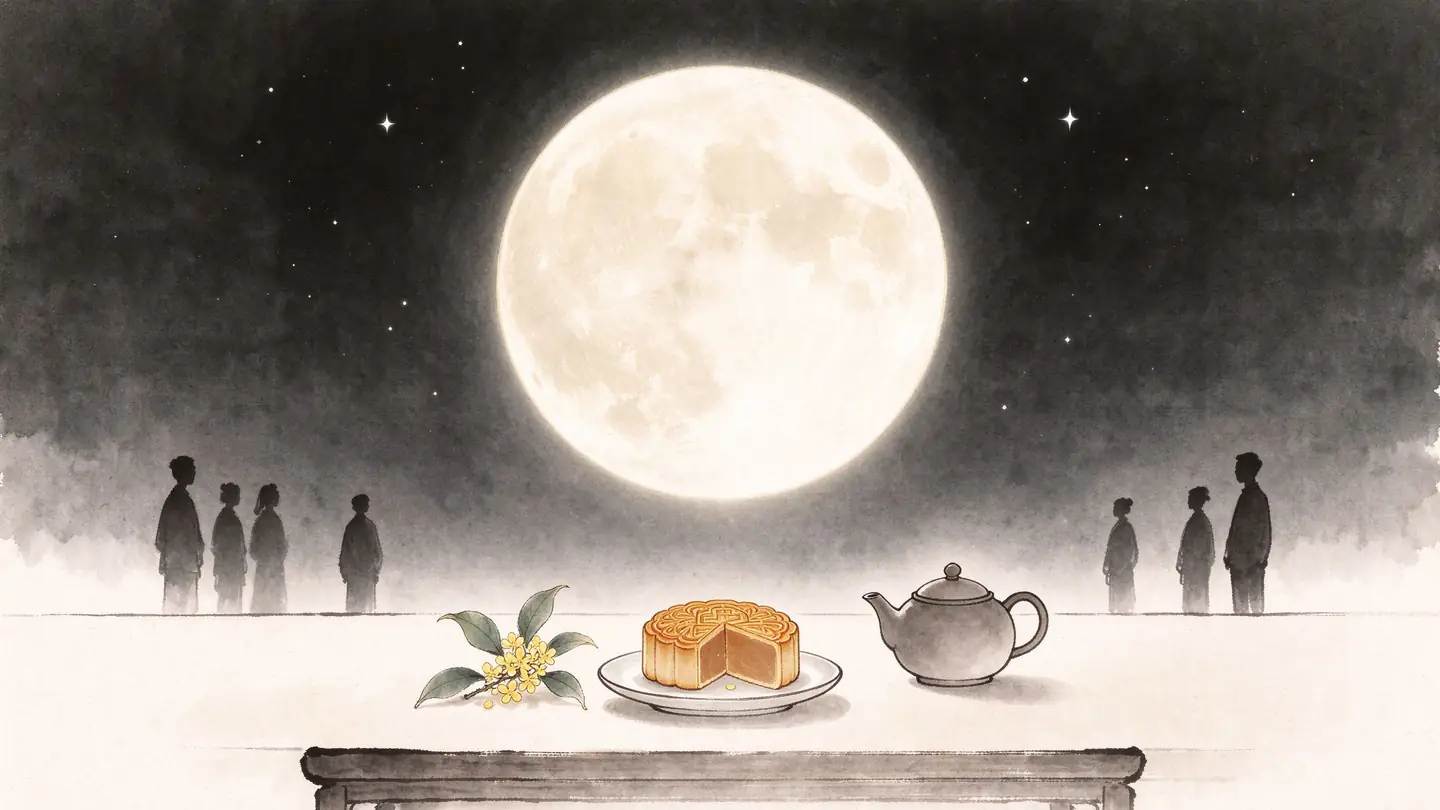
- Fruit, mooncakes, taro, pomelo and tea are arranged on a tray and set outside, facing east, the direction the moon rises from. Nobody eats until the moon is up.
- Dusk · the reunion dinner
- The main meal, usually at home: a whole chicken, a fish, seasonal crab where it is affordable. The point is who is at the table, not the menu, and the table is often set for one more than are present.
- Evening · moonrise, usually six to seven
- The family moves outdoors to watch the moon climb. Someone points out the Jade Rabbit and Wu Gang; children are told not to point at the moon itself, which is the one rule of the evening.
- Night · cutting the mooncake
- One mooncake is cut into wedges and shared, one piece per person at the table. Cutting it while people are still missing defeats the symbol of wholeness, so the family waits.
- Late evening · lanterns, barbecue, phone calls
- Children carry lanterns; in Guangdong, Hong Kong and Taiwan families run a street-side barbecue. Those far from home call their parents and recite the Su Shi line to the same moon everyone can see.
- Past midnight · the moon at its highest
- The last of the tea is poured away and the table cleared. Many people photograph the moon and drop it into the family group chat, which has quietly become part of the modern ritual.
What people do Customs & activities
- Moon gazing (赏月)
- Families sit outdoors with a table of fruit, mooncakes and tea, and simply watch the moon rise. It is the whole event; nothing else is required to happen, and the waiting is the point.
- Eating mooncakes (吃月饼)
- A dense pastry, most often lotus seed paste with a salted duck egg yolk in the middle, representing the full moon. One mooncake is typically cut into wedges and shared.
- Carrying glowing lanterns
- Children walk with lit lanterns, especially in southern China and in Hong Kong, where the Tai Hang fire dragon dance fills the streets for three nights around the festival.
- Barbecue outdoors (烧烤)
- An odd but real tradition: in Guangdong, Hong Kong and Taiwan, families barbecue outdoors on Mid-Autumn night. Nobody is quite sure how it started, and everyone has a theory.
- Watching the Qiantang bore
- In Zhejiang, the festival coincides with the year's largest tidal bore on the Qiantang River, and crowds go to watch the water surge upstream in a single moving wall.
- Admiring the osmanthus bloom
- Osmanthus blooms in the eighth lunar month. Osmanthus wine, tea and cakes are the flavour of the season, and the flower is also the cassia tree said to grow on the moon.
- Cutting the mooncake together
- One mooncake is cut into wedges and shared, a piece for each person present. Who cuts it, and how evenly the pieces go, is watched; cutting it while someone is absent defeats the round shape's meaning.
- Sending mooncakes to relatives
- Boxes go out before the fifteenth to parents, in-laws, teachers and colleagues, often delivered by hand or courier. The gift carries a greeting so that nobody has to phrase one, which is much of its social function.
- Telling the rabbit's story to children
- Parents point out the markings on the moon and name the Jade Rabbit and the man cutting the cassia tree. It is how the festival is passed on, one retelling at a time, without anyone opening a book.
How it varies across China Regional differences
- The mooncake map: Cantonese vs everyone
- Cantonese lotus-paste with yolk dominates the south and most export boxes. Suzhou and Shanghai favour flaky savoury pastry, Yunnan is known for its ham-filled cakes, and the north still argues for the nutty five-kernel style.
- North vs South: what is on the table
- The south adds taro, pomelo and water caltrop, and often ends the night with a barbecue. In the north the emphasis stays on fruit, cakes and the moon itself, with a bigger role for family visits the next day.
- Coastal vs inland traditions
- Zhejiang crowds the Qiantang River for the year's biggest tidal bore, which coincides with the festival. Inland cities have no such tide, and the evening stays closer to home: a table, a roof and the moon.
- How it changes overseas
- Chinatowns in San Francisco, London and Sydney hold lantern parades and mooncake fairs on the nearest weekend, since the date is not a public holiday abroad. The gift boxes travel by courier regardless of geography.
- The same full moon across East Asia
- Chuseok in Korea and Tsukimi in Japan honour the same harvest moon on nearly the same date, each with its own foods and greetings. The moon is shared; the menus are not.
What to say — and what not to Greetings
- Say: 中秋快乐 or 阖家团圆
- 'Happy Mid-Autumn' or 'may your whole family be reunited'. Prefer the second: the festival is about reunion, not partying, and 阖家团圆 says exactly that. To an elder, add a wish for good health.
- To someone far from home
- Send the Su Shi line written nine centuries ago: 但愿人长久,千里共婵娟, 'may we all live long, and share this same moon though a thousand miles apart.' It is the standard thing to say to anyone who cannot come home.
- To elders: lead with health, not festivity
- With parents and grandparents, 身体健康 ('good health') or 阖家幸福 ('family happiness') carries more weight than 快乐. The older the recipient, the more the greeting is about wellbeing and the less about the party.
- To peers: the moon line, or nothing clever
- Between friends, 中秋快乐 plus a riff on the moon is enough — the Su Shi line, or 'send me a photo of your moon'. Long, ornate greetings read as copied from a template and are the ones people ignore.
- With the gift, the number matters more than the words
- Mooncakes go in even numbers, four or eight to a box, and never one; avoid a set of four where the pun on the number four is unwelcome. The etiquette lives in the count, so a plain 中秋快乐 handed over with both hands is enough.
- Don't say 'happy' to a family in mourning
- In some regions a recently bereaved family does not celebrate. 中秋安康 ('peace and health') is the gentler greeting; 快乐 can land badly, the same way it does at a memorial day.
How to prepare Before the day
- Buy mooncakes early — properly early
- Good bakery mooncakes are pre-ordered weeks in advance and sold out a fortnight before the day. Supermarket boxes survive to the last minute; the famous ones do not.
- Book the trip home well ahead
- It is the second-largest travel peak of the Chinese year after Spring Festival, and the busiest single weekend for domestic flights. Trains sell out early, especially on the days either side of the fifteenth.
- Plan the reunion dinner
- The meal is usually at home on the fifteenth, with the moon-watching to follow. Hairy crab is in season and is the most traditional splurge, so reserve it in advance if you want it.
- Buy lanterns for children
- Paper lanterns with a candle, or the modern plastic-and-LED ones. In Hong Kong and the south this is the one festival where children get street lights of their own and stay out late.
- Set out a table for the moon
- Fruit, mooncakes, taro, pomelo and tea, arranged on a tray and left out under the moon before anyone eats. Facing east lets the tray catch the moon as it climbs.
- Pick where you will watch from
- A rooftop, a park, a riverbank facing east. Somewhere with a clear eastern horizon is the whole secret, since that is the direction the moon comes up from.
- Reserve hairy crab early, and know the price
- Hairy crab is the traditional splurge of the season and peaks around the festival. Reputable sellers take orders in early September, and prices are highest in the week before the fifteenth.
What not to do Taboos
- Never gift a single mooncake
- Mooncakes must be given in even numbers, usually four or eight to a box. One is what you leave for the dead, and the count is the part of the etiquette people notice first.
- Never send mooncakes after the festival
- The gift is worth nothing once the day has passed; it reads as regifting. Everything must arrive before the fifteenth, so book the courier in good time.
- Do not point at the full moon
- An old belief that pointing at the moon will cut your ear — the standard Chinese warning to children, and a lingering mark of disrespect towards something that is being honoured.
- Avoid four in a set
- 四 sounds like 死 (death). Boxes come in two, six, eight, or nine, and the reason is entirely phonetic. A box of four is the mistake a foreign buyer makes most often.
- Avoid white or black wrapping
- Funeral colours. Red, gold or warm neutrals are correct for a gift box, and the wrapping says as much about the giver as the mooncakes inside it.
- Do not cut the mooncake before the family is gathered
- The round shape stands for reunion. Cutting it up while people are still missing defeats the symbol, which is why families wait until everyone who is coming has arrived.
- Do not gift pears with the mooncakes
- 梨 sounds like 离, separation — the exact opposite of what the festival is about. Even a well-meant box of fruit can carry the wrong message if it includes pears.
- Do not treat it as a party weekend
- The festival's grammar is reunion, not celebration. If you are with Chinese colleagues, asking whether they are going home for it is a more welcome question than proposing drinks.
- Do not eat a whole mooncake alone
- A mooncake is dense, often 700 to 1,000 calories, and meant to be shared. Serving yourself a whole one, or cutting a second before the first is finished, is the small mistake everyone notices and few mention.
- Do not point out who is missing
- If a relative cannot come home, the table still holds their place in the count. Naming the absence as a failure of the reunion, rather than a fact of it, is the one remark that reliably lands badly.