
Little New Year
小年 · Xiǎo Nián
The story behind it Origin & legend
Little New Year is the day the Kitchen God is sent back to heaven. He is the household's resident deity, believed to watch over the family all year from a spot above the stove, and on this day he returns to report on them. Families offer him something sweet so that his report is sweet, then sweep the house and begin the final countdown to Spring Festival.
The date is split. Most of northern China keeps Little New Year on the twenty-third day of the twelfth lunar month, and most of the south on the twenty-fourth. One common explanation is 'officials on the twenty-third, commoners on the twenty-fourth', with a further version giving boat-dwelling families the twenty-fifth. The split is old and still visible today, and neither date is wrong in its own region.
The Kitchen God is one of the few household gods traditionally kept in an ordinary home. His paper image or tablet hung above the stove, and the year's accounting was believed to rest on his report. Sweets — sticky malt-sugar candies — were offered partly to please him and partly, in the joking folk reading, to glue his mouth shut before he spoke.
Today the stove-top image is rare, but the day survives strongly as a start signal. Supermarkets sell ready-made malt-sugar candy and cleaning supplies, cleaning services book out three weeks ahead, and families still divide cleanly along the old line: northern twenty-third, southern twenty-fourth.
What it means Cultural significance
- The countdown formally begins
- Little New Year opens the last week before New Year. From here cleaning, shopping, haircuts and the settling of accounts are all meant to be done, so that nothing old is carried across into the new year.
- A household's own accounting
- The Kitchen God's report is a story about a family being honest with itself. The year's good and bad deeds go up to heaven; the sweets are less a bribe than a wish for a kind verdict.
- A clean house as a clean start
- Sweeping on Little New Year is not ordinary tidying but ritual: dust is cleared out to remove the past year's bad luck. Every corner is done, because what is left behind is left for the whole year ahead.
- A day that is quietly regional
- Little New Year is the clearest case in the calendar of China not having one national date. The north–south split is a live fact, remembered yearly, and it makes the festival a small lesson in local identity.
- Warmth at the coldest point of winter
- Falling in the coldest stretch of the year, the festival is domestic: sweets, a warm stove, a swept room. Its comfort is small and literal, and that is exactly the point of it.
- A festival run by the household, not the state
- Unlike the public holidays, Little New Year has no parade and no official ceremony. Its rituals are carried by whoever cooks, cleans and keeps the stove — which is also why the traditions differ so much from home to home.
Hour by hour A day in the festival
- Early morning · the deep clean starts
- Little New Year usually opens with the sweep. Ceilings, corners, windows and bedding are worked through, and the job often continues over several days up to New Year's Eve.
- Late morning · the offering is set out
- Sweets, sometimes fruit and a cup of tea, are placed before the stove-top image of the Kitchen God. In older homes the whole household joins; in flats the offering may shrink to a plate of candy.
- Midday · the image is sent off
- The old paper image is taken down and burned — outdoors, in a metal tray, or at a temple furnace where open burning is banned. This is the moment the god is believed to leave for heaven.
- Afternoon · window flowers and shopping
- Red paper is cut into window decorations, and the house is stocked with sweets, red paper and food. It is the first genuinely busy shopping day of the season.
- Dusk · a modest family meal
- The meal is small — dumplings in the north, rice cake or sweets in the south — but it opens a run of festive eating that builds all the way to New Year's Eve.
- Evening · the countdown is planned
- Lists are made: what to clean, buy, give and settle. From Little New Year the whole household, not just the cook, is on the New Year clock.
What people do Customs & activities
- Sending off the Kitchen God (祭灶)
- Sweets, and sometimes fruit, are set before the stove-top image, and the old paper image is then taken down and burned, releasing the god to heaven. A new image goes up days later for the new year.
- Sweeping the house (扫尘)
- A top-to-bottom clean: ceilings, corners, bedding and windows. The dust of the past year is swept outwards, and in many homes the job runs on until New Year's Eve.
- Eating malt-sugar candy (吃灶糖)
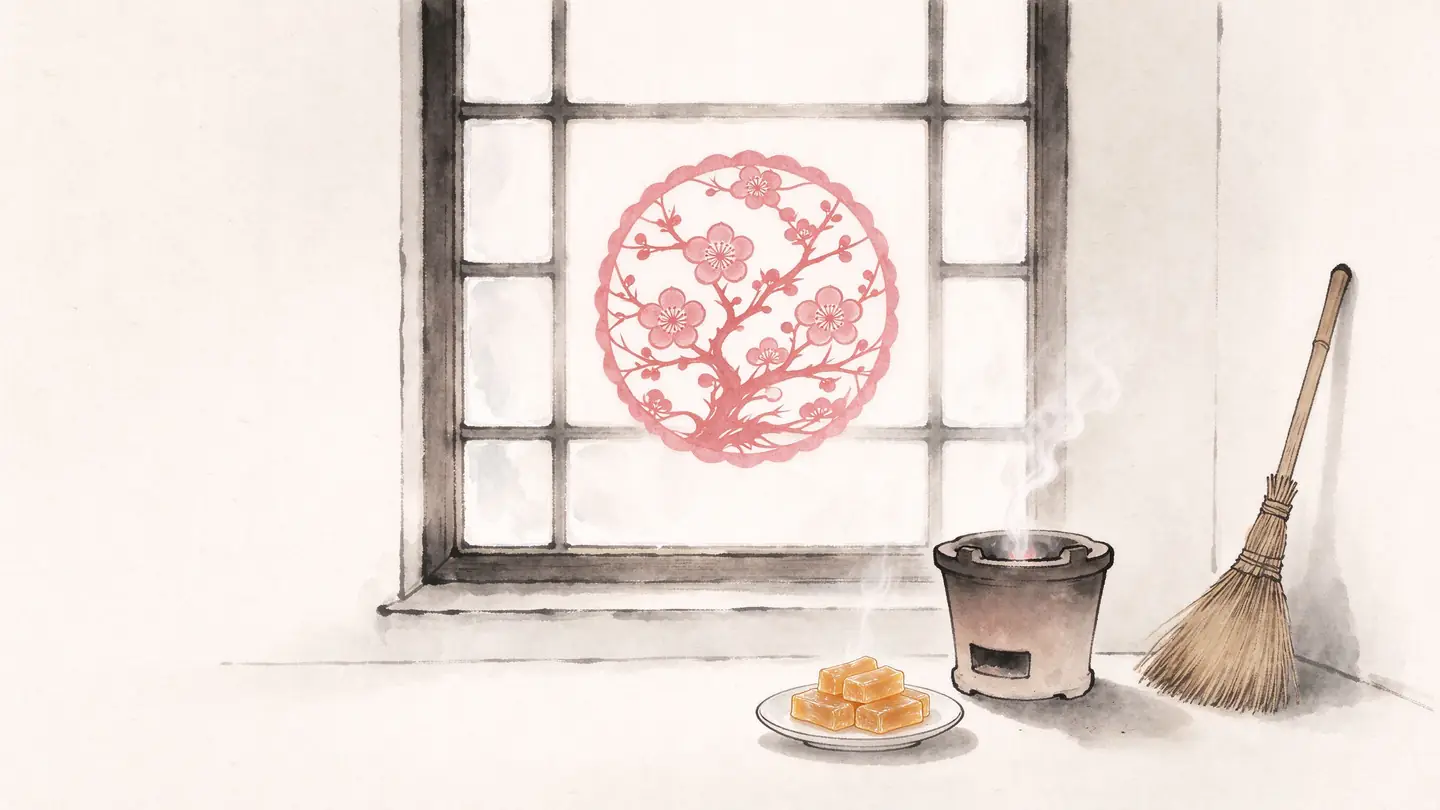
- Pale, sticky malt-sugar sweets are offered to the Kitchen God and then shared. Their stickiness is the joke and the point: sweet words, or a sealed mouth.
- Cutting window flowers (剪窗花)
- Red paper is folded and cut into animals, flowers and good wishes, then pasted on the windows. It is one of the first decorative jobs of the New Year season and is often done with children.
- Bathing and a haircut
- The old rule is to wash and cut your hair before New Year, so nothing from the old year is carried in. Salons and barbers are at their busiest from Little New Year onwards.
- Making New Year bread (蒸花馍)
- In parts of the north, families steam decorated buns shaped into animals and flowers, both to eat and to give away. The steamer stays busy for several days.
- Adjusting the household accounts
- Little New Year is the traditional deadline for settling debts and returning what was borrowed, so that the family enters the New Year square. Creditors were once expected to stop calling after this day.
- A small family meal
- The meal is modest — dumplings in the north, or rice cake and sweets in the south — and it opens a run of festive eating that builds towards New Year's Eve.
How it varies across China Regional differences
- North vs South: the 23rd or the 24th
- The single best-known difference. The north keeps Little New Year on the twenty-third of the twelfth month; the south, on the twenty-fourth. The split is centuries old, and both dates are fully correct in their own region.
- One common explanation: officials and commoners
- A widely told account is that officials once observed the day on the twenty-third and ordinary people on the twenty-fourth, with boat-dwelling families on the twenty-fifth. It is one explanation among several, not a settled fact.
- The sweets differ by province
- Northerners eat sticky malt-sugar sweets; some Henan households add small baked cakes; rice-growing regions lean towards rice cake and sticky rice sweets. The offering is always sweet, but the form changes with what grows locally.
- What the clean looks like
- Urban families now outsource the deep clean or run it over several days; rural households still do the whole job by hand, ceilings to floorboards. The schedule differs; the goal does not.
- Overseas: the date the family chose
- Overseas, Little New Year is usually set by whichever date the family's home province follows, so a single city can hold both the twenty-third and the twenty-fourth. Chinese groceries stock the sweets for both dates.
What to say — and what not to Greetings
- Say: 小年快乐
- A light 'happy Little New Year' is common and safe between friends and family. The day is a domestic start to the season rather than a formal occasion, so the greeting stays casual.
- Say at the stove: the traditional send-off words
- When the old Kitchen God image is burned, the traditional wish is for him to speak well in heaven and bring good fortune back — in short, 上天言好事, 'report good things above'. It is a wish addressed to the god, not a greeting to a person.
- To whom: family and neighbours, not colleagues
- Because it is a household festival, greetings go to family and close neighbours. A formal 小年快乐 to a business contact is unusual; it is not a public holiday, and it is not a work occasion.
- Don't say: the wrong date if you know theirs
- If a southern friend keeps the twenty-fourth, greet them then, not on the twenty-third. The one-day split is exactly the point many families care about, and getting it right shows attention. Both dates are correct in their region.
- If you don't observe it: a simple acknowledgement
- For friends who do not keep the day, no greeting is needed, and a brief 'clean sweep for the New Year' is enough. Little New Year is private by nature; it does not need to be marked by everyone.
How to prepare Before the day
- Buy the sweets before they sell out
- Malt-sugar candy and the melon-shaped sweets are a seasonal item and disappear from the shelves quickly around the twenty-third. Buy a few days early, and buy enough to share as well as to offer.
- Book the cleaning help now, not later
- If the deep clean is being outsourced, city cleaning services are booked out roughly three weeks before New Year. Little New Year is the last sensible moment to arrange it.
- Confirm which date your family keeps
- Northern families clean on the twenty-third, many southern families on the twenty-fourth. If relatives come from different regions, agree on the day in advance — the split is real and older people notice it.
- Get the haircut early
- Barbers and salons are overwhelmed in the last week before New Year and raise their prices. Go at Little New Year or just before, not on New Year's Eve.
- Make a cleaning plan by room
- The sweep is not one job but a list: ceilings and corners first, then bedding, windows, kitchen. Working room by room stops the task from stalling halfway through.
- Buy red paper for window flowers
- Red paper, scissors and paste for the window decorations are cheap but sell down; buying early lets children make them over several evenings rather than in a last-minute rush.
- Decide what is being given away
- Little New Year is the moment to set aside clothes and goods for donation and to clear debts, so that the house and the accounts are both a little lighter before the New Year.
What not to do Taboos
- Do not leave the house half-swept
- The clean is meant to be thorough and, in many homes, finished before New Year's Eve. Stopping halfway is read as carrying the old year's dust — and its luck — into the new one.
- Do not put the new stove image up too early
- The old Kitchen God image is sent off at Little New Year, but the replacement traditionally goes up days later, near New Year's Eve. Putting it up immediately muddles the send-off and the welcome into one act.
- Do not offer the Kitchen God bad or savoury food
- The offering is sweet by design. Sour, bitter or salty food was once thought to give the god a sour report, which is the opposite of what the day is for.
- Do not overlook the north–south date
- Telling a southern family they have the 'wrong' day, or a northern family likewise, misses the point. Both dates are long-established, and the officials-and-commoners explanation is one account among several, not a settled rule.
- Do not start a major new venture today
- The month belongs to closing the year, not to opening things. Starting a business, signing a large contract or moving house in the last week is traditionally avoided — and in practice, everyone is too busy anyway.
- Do not lend money on Little New Year
- The day is for calling in what is owed and clearing debts; lending money out is believed to set a year of money leaving the household. Say you will sort it out after New Year.
- Do not be careless with fire during the send-off
- Burning the old image and paper outdoors needs care, especially in dry winter air and in city districts where open burning is restricted. A metal tray or a temple furnace is the safe option.
- Do not forget the sweets are for sharing
- Buying the candy and eating it alone skips the ritual. The sweets are offered first and then shared around the family, which is what makes the day warm rather than merely sweet.