
Dragon Boat Festival
端午节 · Duān Wǔ Jié
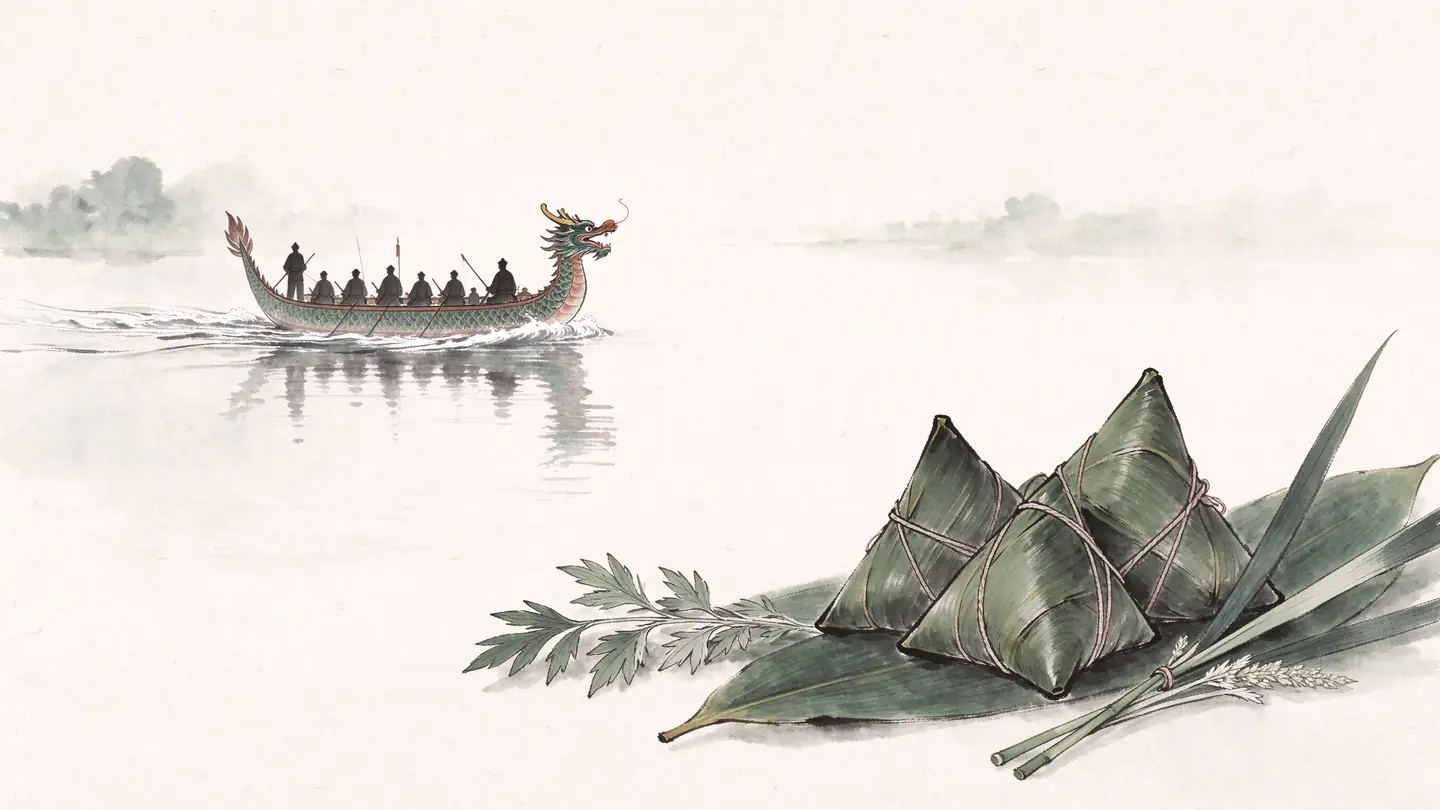
The story behind it Origin & legend
Two festivals are stacked on one date. The older layer has nothing to do with any poet: the fifth lunar month was counted as the 'poisonous month', the weeks when heat, insects and water-borne disease all arrived together. Households hung mugwort and calamus on the doorframe, bathed in herb water and sewed scented sachets for the children — practical prevention, dressed as ritual. Some scholars treat this midsummer health festival as the original Duanwu and everything else as later additions.
The layer most people know is Qu Yuan (c. 340–278 BC), a minister and poet of the state of Chu. Slandered at court and exiled by his king, he watched his country slide towards conquest. By tradition, when the capital fell he walked into the Miluo River holding a stone. Villagers rowed out, beating drums to drive the fish from his body and throwing rice into the water so the fish would eat that instead. The boats became dragon boats; the leaf-wrapped rice became zongzi.
The festival kept moving. In 2009 Chinese Duanwu was added to UNESCO's intangible heritage list, and since 2008 it has been a public holiday on the mainland. Firecrackers and river bathing are now restricted in many cities, while dragon-boat racing has turned into a global sport with clubs in London, Toronto and Sydney.
In some regions the day is tied to other figures instead — the minister Wu Zixu, or the filial daughter Cao E — a reminder that the festival was observed long before any single story won out.
What it means Cultural significance
- Loyalty when it costs everything
- Qu Yuan is the archetype of the honest official who will not flatter. The festival is a yearly public reminder that integrity is worth more than survival, and that some careers end badly on purpose.
- A health festival in disguise
- Everything hung, worn or drunk on this day is about summer disease: mugwort is antiseptic, calamus is an insect repellent, and realgar wine was used as a traditional pesticide before anyone called it medicine.
- Community, expressed as a race
- Dragon boat racing is the one traditional Chinese festival activity that is genuinely a team sport, with a drummer setting the pace and twenty paddlers pulling as one — a rare case of collective effort built into the calendar.
- A festival China shares with its neighbours
- Variants are celebrated in Korea, Japan, Vietnam and across Southeast Asia, which is a reminder of how far the lunisolar calendar once travelled and how many local stories grew on the same date.
- Summer safety, encoded as custom
- The ban on swimming and the herbs over the door are the same idea said twice: in the hot fifth month the water and the insects really are dangerous, and a rule wrapped in ritual is one people actually keep.
- A holiday about character, not consumption
- Duanwu has no gift economy and no banquet to host, which sets it apart from almost every other major Chinese festival. Its central figure refused to compromise, and its central act is remembering him rather than buying anything.
Hour by hour A day in the festival
- Early morning · herbs on the door
- A bundle of mugwort and calamus is tied at the outer door, stems up, before the day's heat builds. In some markets the same bundles are sold from carts and gone by mid-morning.
- Morning · sachets and coloured thread
- Children are given a scented sachet for their clothing and a five-colour thread knotted on the wrist. The thread stays on until the first rain, then is cut and dropped into running water.
- Late morning · the zongzi pot goes on
- If the family is wrapping its own, leaves and rice were prepared the night before and the bundles now steam for two to three hours. The smell filling the kitchen is the day's real beginning.
- Noon · the egg trick
- At midday, the fifth hour of the fifth day, families try to stand a boiled egg on its end. Onlookers crowd round and children shriek; it is a serious game played for no prize.
- Afternoon · the race
- If there is water nearby, this is when the dragon boats run: a drummer at the bow setting the pace, twenty paddlers pulling together, the crowd along the bank shouting the count.
- Evening · the family meal
- Dinner gathers the household around the zongzi, salted eggs, eel and a symbolic glass of realgar wine. It is a quiet meal; this is not a festival of firecrackers.
- Night · herb bath, then first rain
- In the south, households wash in herb water boiled the night before. Days or weeks later, when the first heavy rain of the season falls, the coloured threads come off and are sent down a stream to carry sickness away.
What people do Customs & activities
- Dragon boat racing
- Long narrow boats with a dragon head and tail, twenty paddlers, one drummer, one steerer. Races now run in London, Toronto, Sydney and San Francisco as much as in Guangdong and Hunan.
- Eating zongzi (粽子)
- Glutinous rice wrapped in bamboo or reed leaves and steamed for two to three hours. Sweet in the south with red bean or jujube; savoury with pork belly and egg yolk along the Yangtze and in the north.
- Hanging mugwort and calamus (挂艾草 · 菖蒲)
- A bundle tied to the doorframe on the morning of the festival, stems up, and usually left up until it dries. The bitter smell is the point: it keeps insects out of the house through the worst of the summer.
- Wearing a scented sachet (香囊)
- Embroidered pouches filled with mugwort, angelica and asarum, hung on children's clothing. The herbs are chosen precisely because insects avoid them, so the sachet is a small wearable insect repellent.
- Tying the five-colour thread (系五彩绳)
- Braided silk in five colours knotted on a child's wrist, left on until the first heavy rain, then cut and dropped into running water to carry the year's sickness away.
- Standing an egg at noon
- A much-loved game: at midday on the fifth, families try to balance a fresh egg on its end. It is a children's contest with a straight face, and the whole street joins in.
- Herb-water bath (洗草药澡)
- In parts of the south the household washes in water boiled the night before with mugwort, calamus, pomelo leaves and more. The bath is believed to clear the skin and rinse off the month's dirt and bad luck.
- Sending zongzi to relatives
- Families wrap far more zongzi than they can eat and deliver the surplus to neighbours and elders. This is a gift exchange, not a by-product; the parcel carries the greeting so that nobody has to phrase one.
- Eye-dotting a dragon boat (点睛)
- Before a race, the boat's carved head is ritually awakened by painting in its eyes. It blesses the crew and opens the event; without the rite, as the saying goes, the boat is only wood.
How it varies across China Regional differences
- North vs South: what goes in the zongzi
- The south tends to sweet — red bean, jujube, plain glutinous rice. The north and the Yangtze valley lean savoury, with pork belly, salted egg yolk or chestnut. Neither side thinks the other is the real one.
- Where dragon-boat racing is serious business
- Competition is densest along rivers and in the south — the Pearl River delta, Hunan and Fujian. Inland and northern cities often mark the day with food and herbs but no race, because there is no convenient water.
- Which herb goes on the door
- Mugwort and calamus are the common pair, but the exact bundle shifts with the region: some households add garlic, others pomegranate flowers or extra artemisia. The purpose is constant, and the ingredients rarely are.
- How it changes overseas
- In London, Toronto, Sydney and San Francisco the racing moves to the nearest weekend and becomes a public water festival, with club teams, food stalls and crowds who have never wrapped a zongzi themselves.
- The same day in neighbouring countries
- Korea marks Dano, Japan its Boys' Festival, and Vietnam Tết Đoan Ngọ. The shared calendar explains the shared date; the stories attached to it differ in each place and were never standardised.
What to say — and what not to Greetings
- Say: 端午安康
- Duānwǔ ānkāng — 'a peaceful, healthy Dragon Boat Festival'. The day remembers Qu Yuan, a poet who drowned himself in 278 BC, so it is a festival of remembrance rather than celebration. 安康 means health, peace and safety, and it matches the mood.
- Don't say: 端午快乐
- 'Happy Dragon Boat Festival'. It is not a crime, but a Chinese colleague will notice. Save 'happy festival' greetings for joyous days such as Spring Festival or Mid-Autumn, and use 安康 here instead.
- Safe fallback: 平安 or 安康
- If you are unsure, 'may you stay safe and sound' — 祝您平安 or 祝您安康 — is never wrong. 平安 works for any age, any setting and any relationship, which is exactly why it is the safe choice.
- To whom: elders first, and keep it gentle
- Greet parents and grandparents before friends. With an older person, 身体健康 ('good health') carries more weight than any festive line, because on this day health is the entire point.
- If you are sending zongzi: let the gift talk
- One short line is enough — '端午安康,记得吃粽子' ('peace and health; don't forget the zongzi'). Warm without being effusive, which is the right register for a memorial day.
How to prepare Before the day
- Order or make zongzi in advance
- Good zongzi take hours to steam. If you are making your own, buy bamboo leaves and soak both the leaves and the rice the night before; if you are buying, order a week ahead.
- Buy mugwort and calamus before the day
- They sell out on the morning of the festival at every market, and bundles are cheapest at the weekend before. Tie them into a bundle and hang them at the outer door on the fifth.
- Find your local dragon boat club
- Most large overseas Chinese communities and many city rowing clubs run races on the nearest weekend. Teams often take beginners, and training sessions start weeks earlier in late spring.
- Make or buy sachets for children
- Craft versions are a good activity for kids; the herb mix is usually mugwort, angelica and mint. Buy a month ahead if you want the good embroidered pouches, which sell out first.
- Decide your greeting in advance
- Say 端午安康 (peace and health), not 端午快乐 (happy festival). Decide this before you meet anyone, because the correct line is the one nobody reaches for by default.
- Learn to fold a zongzi properly
- The fold is the skill: two leaves overlapped into a cone, rice filled to about two-thirds, the top folded over and tied tightly. Loose wrapping leaks in the pot; a firm tie holds the shape through hours of steaming.
- Check whether racing is on, and where
- Overseas races usually fall on the nearest weekend, not the fifth itself. Clubs post their schedules in late May, and the best viewing banks fill by nine in the morning, so arrive early or watch from a bridge.
What not to do Taboos
- Do not say "Happy Dragon Boat Festival"
- The most useful thing a visitor can know. The day marks a death and once warded off disease, so the greeting is 端午安康 ('peace and health'), never 端午快乐 ('happy festival'). The wrong wish to an elder is a faux pas.
- Do not go swimming in rivers, lakes or the sea today
- A strong folk taboo across southern China, tied both to Qu Yuan's drowning and to the belief that the water is dangerous in the poisonous fifth month. Drowning statistics do spike around this date.
- Do not hang mugwort after noon
- The apotropaic herbs are supposed to go up in the morning, before the day's heat peaks. Hanging them late is considered pointless, and markets that sell them shut by midday anyway.
- Do not give zongzi in inauspicious counts
- Not a single one — offerings to the dead are given singly. Gift in pairs or larger even numbers, and never send them after the festival, when they read as an afterthought.
- Do not give away the five-colour thread
- It is tied on a specific child for a specific reason; taking it off early, or passing it to someone else, defeats the purpose. It comes off only at the first rain, and then into running water.
- Do not break the leaves before cooking
- A torn zongzi leaf lets the rice out and is traditionally read as letting good fortune escape. Wrap with two leaves if one is fragile, and tie snugly rather than tightly enough to split the leaf.
- Do not refuse a neighbour's zongzi
- Accepting and eating at least one is the polite answer; handing a zongzi straight back reads as rejecting the relationship. If you cannot eat it, thank the giver and pass it to someone who can.
- Do not let a small child wear the sachet to bed
- The herbs are strong and the hanging cord is a strangling risk for infants. The pouch belongs on clothing during the day and comes off at night, along with the wrist thread.
- Do not hang the herbs the wrong way
- Tradition wants the bundle at the outer door, stems up, tied at the doorway in the morning. Keeping it entirely indoors, or fixing it upside down, is said to point the protection the wrong way.