
Ghost Festival
中元节 · Zhōng Yuán Jié
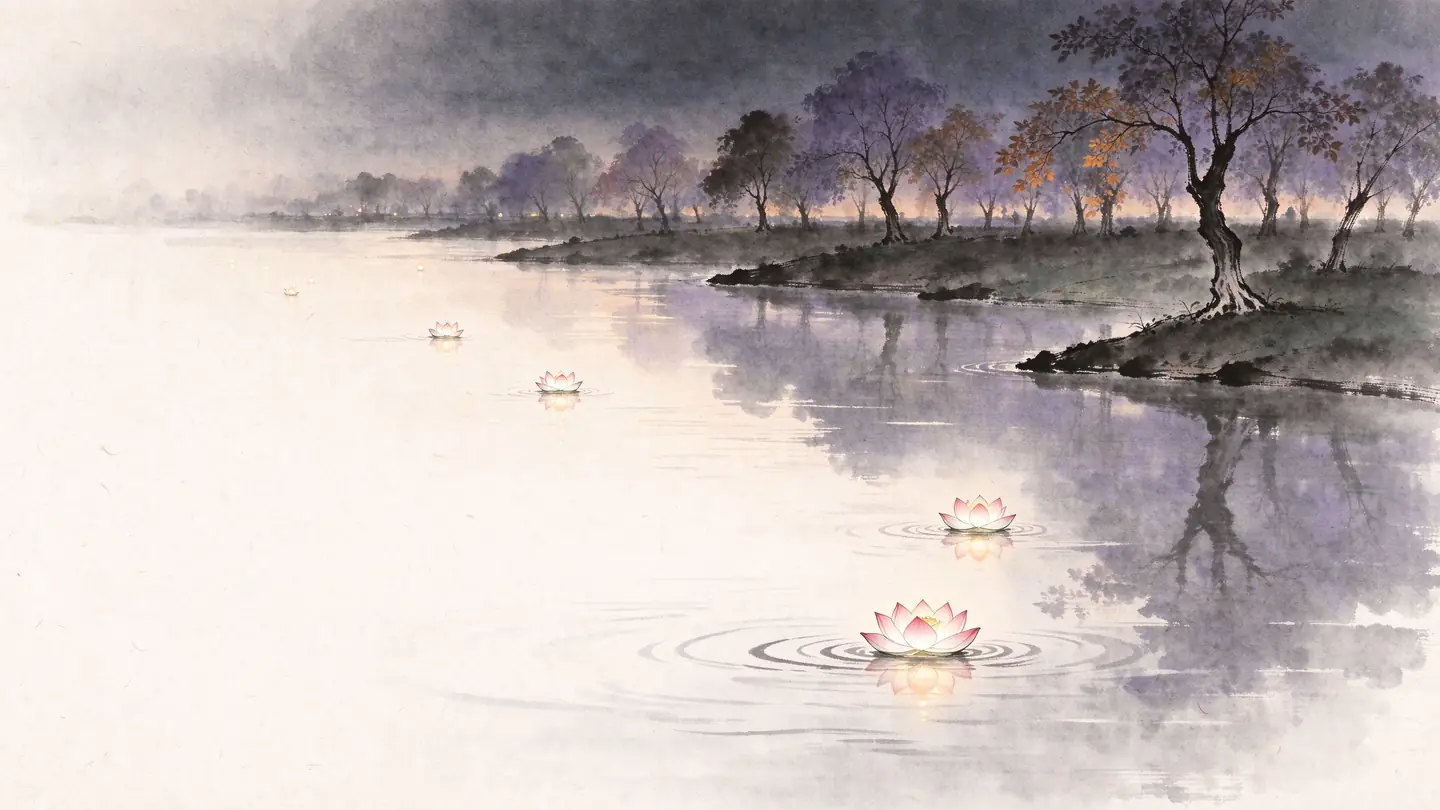
The story behind it Origin & legend
Ghost Festival sits at the centre of Ghost Month, the whole seventh lunar month, when the gates of the underworld are believed to open and the dead are free to walk. The fifteenth is the peak.
It has two parents. From Taoism comes 中元节, the day the official of the middle realm forgives sins. From Buddhism comes 盂兰盆节 (Ullambana), the story of Maudgalyayana, a disciple of the Buddha who saw his late mother suffering in the realm of hungry ghosts and could not help her with his own powers. The Buddha told him to make offerings to the whole monastic community on the fifteenth day of the seventh month, and by that shared merit she was released. The moral of the story — that you save your ancestors by feeding strangers — is what the festival is for.
Ghost Month faded in mainland cities during the twentieth century, where it was long treated as superstition, and it survives most strongly today in Hong Kong, Taiwan, Singapore, Malaysia and overseas communities. The ritual core has held regardless: families still cook, set a place for the ancestors and, on the fifteenth, send off the wandering spirits before the month turns.
Its three names point to three traditions that share one day. The Taoist middle day of the year, the Buddhist rite of shared merit, and the folk observance of the dead all land on the fifteenth of the seventh month. In practice most families keep it simply as the day to remember their own ancestors.
What it means Cultural significance
- Care for the dead who have no one
- Ghost Month is not only about your own family. Much of the ritual is aimed at wandering spirits with no descendants to feed them — the genuinely forgotten, whose only offerings come from strangers.
- Generosity as a mechanism, not a mood
- The Buddhist logic is explicit: merit generated by giving to the living community is transferred to the dead. It is a transaction with terms and a date, and the festival is when it settles.
- The living negotiate with the unknown
- The taboos — no swimming, no late nights, no picking up money from the street — are a month-long etiquette for a period when the world is believed to be less safe than usual.
- A family-reunion festival in disguise
- In practice, families gather on the fifteenth, cook, and set out a place for the ancestors. Structurally it looks a great deal like Qingming, but at night and with more food.
- Strongest overseas, in some ways
- In Singapore, Malaysia, Hong Kong, Taiwan and Chinese communities across Southeast Asia, Ghost Month is observed more visibly and more strictly than in mainland cities, where the custom has largely faded since the mid-twentieth century.
- 慎终追远 — remembrance as a duty
- The festival's oldest idea is that the living owe the dead continued care: food, a name, a place at the table. Remembering is treated as an obligation that keeps a family's line intact, not a private feeling.
- Turning private grief into public generosity
- The Buddhist logic of Ullambana is that you help your own ancestors by giving to the living community. The festival makes a shared virtue of private grief, which is why its central acts are offerings given to strangers.
Hour by hour A day in the festival
- Morning · clean the family altar
- Before anything is offered, the home altar or the ancestral shelf is cleaned and the old incense cleared away. The ancestors are received into a tidy house, which is the point of starting early.
- Late morning · cooking for the offering
- The family cooks a full meal, usually three or five dishes, and sets the ancestors' favourites aside. Food is laid out with chopsticks and a little wine before anyone eats.
- Midday · incense and paper money
- Incense is lit and joss paper burned, at home or at a designated burner. Fewer households burn at the kerb now; where it is banned, a temple incense table stands in for it.
- Afternoon · temple or neighbourhood rites
- Temples and community associations set out long tables of food for the unnamed dead and run the day's ceremonies. In Hong Kong and Malaysia this is when the temporary bamboo opera theatre opens.
- Dusk · floating the river lanterns
- Paper lanterns carrying names and wishes are set on the water as it darkens, the day's most public and most moving act. Blank lanterns are for the spirits with no one left to remember them.
- Night · home before dark
- The practical close of the day is simple: families gather in, the extra place is cleared, and people are indoors by the time the streets empty. The seventh month itself runs on for another two weeks.
What people do Customs & activities
- Setting out offerings (祭祖 · 普渡)
- Food, fruit, wine, chopsticks and incense laid out at home or on a street-side table. The first serving goes to the ancestors, the second to wandering spirits who have no one else.
- Burning paper money and paper goods (烧纸)
- Joss paper, paper houses, paper clothes, even paper phones and cars are burned so the dead have what they need. Banned in many city districts; usually there are designated burners.
- Floating water lanterns (放河灯)
- Paper lanterns set onto rivers and lakes, one per soul being guided home. Spectacular in places like Guilin and along the coast, where the whole water surface fills with small lights.
- Temple ceremonies and opera (神功戏)
- In Hong Kong, Singapore and Malaysia, temporary bamboo theatres are built in car parks and open ground and Chinese opera is performed for an audience of ghosts — with the front row left empty.
- The empty front row
- Wherever the rituals happen, the first row of seats is deliberately left vacant. The seats are reserved for the spirits being honoured, and sitting there is a serious faux pas.
- Setting a place for the ancestors
- Many families set an extra bowl, chopsticks and a chair at the fifteenth's meal, exactly as for a living guest, and pour a little wine. The gesture keeps the family's dead inside the household rather than apart from it.
- Writing a name on the lantern
- A river lantern carries a name or a short wish so that the soul it is meant for can be found. The lantern is launched, not kept — sending it away is the whole point of the rite.
- The community's shared offerings (中元普渡)
- Temples and neighbourhoods set out long tables of food for the unnamed dead, then share the food afterwards. The offering is communal by design: no family is asked to name the strangers it feeds.
How it varies across China Regional differences
- Mainland vs Southeast Asia: how visible it is
- In mainland cities the month is lightly marked and burning is restricted. In Singapore, Malaysia, Hong Kong and Taiwan it is far more visible, with street offerings, getai stages and neighbourhood rituals through the whole month.
- North vs South: the offering table
- Southern households tend to lay out more dishes and to burn more paper goods, including paper models of houses and cars. In the north the rite is usually quieter, often reduced to incense, fruit and a visit to the family grave.
- Where the lanterns are floated
- River lanterns are most elaborate along southern rivers and lakes, and in some coastal towns boats carry them out to sea. In cities without water, the lantern is often a small paper lamp set at a crossroads instead.
- Taoist, Buddhist or folk, region by region
- Where Buddhist temples are strong the day is Ullambana; where Taoist tradition holds it is the middle of the three yuán; in most families it is simply the day to feed the ancestors, with little doctrine attached.
- How it changes overseas
- In overseas Chinese communities the month is kept in family rituals and temple events, often scaled to the neighbourhood. Where burning is illegal, temples collect paper offerings and burn them centrally on the fifteenth.
What to say — and what not to Greetings
- Don't say: a 'happy' greeting of any kind
- This is a day for the dead, so there is no customary happy greeting. Wishing someone a happy festival in Chinese here would sound jarring; the respectful register is quiet and low-key, and often the day passes with no greeting at all.
- Say to the bereaved: 节哀, then 保重
- Jié'āi means 'restrain your grief' and is the standard phrase for someone recently mourning; add 保重, 'take care of yourself'. It is the same phrase used at Qingming, and it fits here for the same reason.
- If you must speak: keep it to peace and safety
- A quiet 平安 ('peace') or 安康 ('health and peace') is acceptable and never out of place. Where a family is making offerings, a short word of respect, or simply helping them carry the table, lands better than any phrase.
- In public: talk about the living, not the dead
- At a temple or by the river on the fifteenth, do not ask which lantern or which offering is for whom. The question is personal; keeping the conversation on the ceremony itself is the polite choice.
- To a friend overseas: ask, then follow
- Many families observe the month privately. A simple 'how does your family mark it?' is welcome; arriving with a jokey greeting is not. Match their tone, and let them lead the conversation.
How to prepare Before the day
- Check the local burning rules
- Singapore, Hong Kong and many mainland districts have designated bins and specific permitted days. Burning on the wrong surface can carry a fine, so check before you buy the paper.
- Prepare the offering set
- Three or five dishes, fruit, a bottle of rice wine, three incense sticks, joss paper. Odd numbers are used for offerings to the dead — the reverse of gifts to the living.
- Choose lanterns if you'll float one
- Biodegradable paper and a candle stub or LED. Write the name and a wish on the side, and choose a stretch of water where the lantern can drift clear rather than snag on the bank.
- Plan to be home early
- If you are observing the festival, the practical version of the ritual is simply: be indoors by dark on the fifteenth. Decide the plan in the afternoon rather than arguing about it after dinner.
- Talk to older relatives first
- Practice varies enormously by region and by family. What your grandmother does matters more than any general guide, and asking is itself part of showing respect.
- Shop two or three days ahead
- Joss paper, incense and offering fruit sell out close to the fifteenth, and prices rise in the last week. Markets stock the paper goods all month, so there is no need to leave it late.
- Agree the form with your family first
- Practice varies by household: some burn paper at the kerb, some lay a table indoors, some only visit a temple. Copying a neighbour's route can be more awkward than simply asking what your own family does.
What not to do Taboos
- Do not swim, or go into rivers, lakes or the sea
- The single most widely observed rule of Ghost Month, across mainland China and all of Southeast Asia. It is a safety rule as much as a folk one, since the seventh month is the middle of the summer swimming season.
- Do not stay out late at night
- Especially alone, and especially near crossroads, bridges, hospitals or cemeteries. The point is not fear so much as a calm, orderly end to the day, spent indoors with family.
- Do not whistle at night
- Whistling is believed to call spirits towards you. Also avoid singing alone after dark. The rule is old and quietly observed even by people who insist they do not believe it.
- Do not step on or move roadside offerings
- Food, fruit and burned paper left at the kerb are not litter. Walking over them, kicking them, or clearing them away is the most offensive thing a passer-by can do.
- Do not pick up money from the ground
- Cash left on a street corner in the seventh month may be a deliberate offering. Taking it is believed to invite the debt, and the custom is observed well beyond the families who set it out.
- Do not sit in the front row of the opera
- Those seats are for the guests being honoured. Arriving early and taking the best spot in the house is the obvious mistake, and the empty row is usually a clear enough sign.
- Do not photograph shrines, altars or the burning
- Especially not with a flash, and especially not at night. Ask before you raise a camera; a family making offerings is not a spectacle, and the request is personal.
- Traditionally, do not marry, move house or open a business this month
- Ghost Month is considered inauspicious for new beginnings in Hong Kong, Taiwan, Singapore and Malaysia. Wedding registries and renovation contractors genuinely go quiet; some couples shift their date by a month.
- Do not tap someone on the shoulder at night
- A folk belief that the shoulder carries a protective flame, and that touching it puts it out. Still observed by plenty of people who insist they do not believe it.
- Do not wish anyone a 'happy' festival
- This is a day of remembrance, not celebration. There is no customary 'happy' greeting; a quiet word of respect, or none at all, is the correct register where families are mourning or making offerings.