
Winter Solstice
冬至 · Dōng Zhì
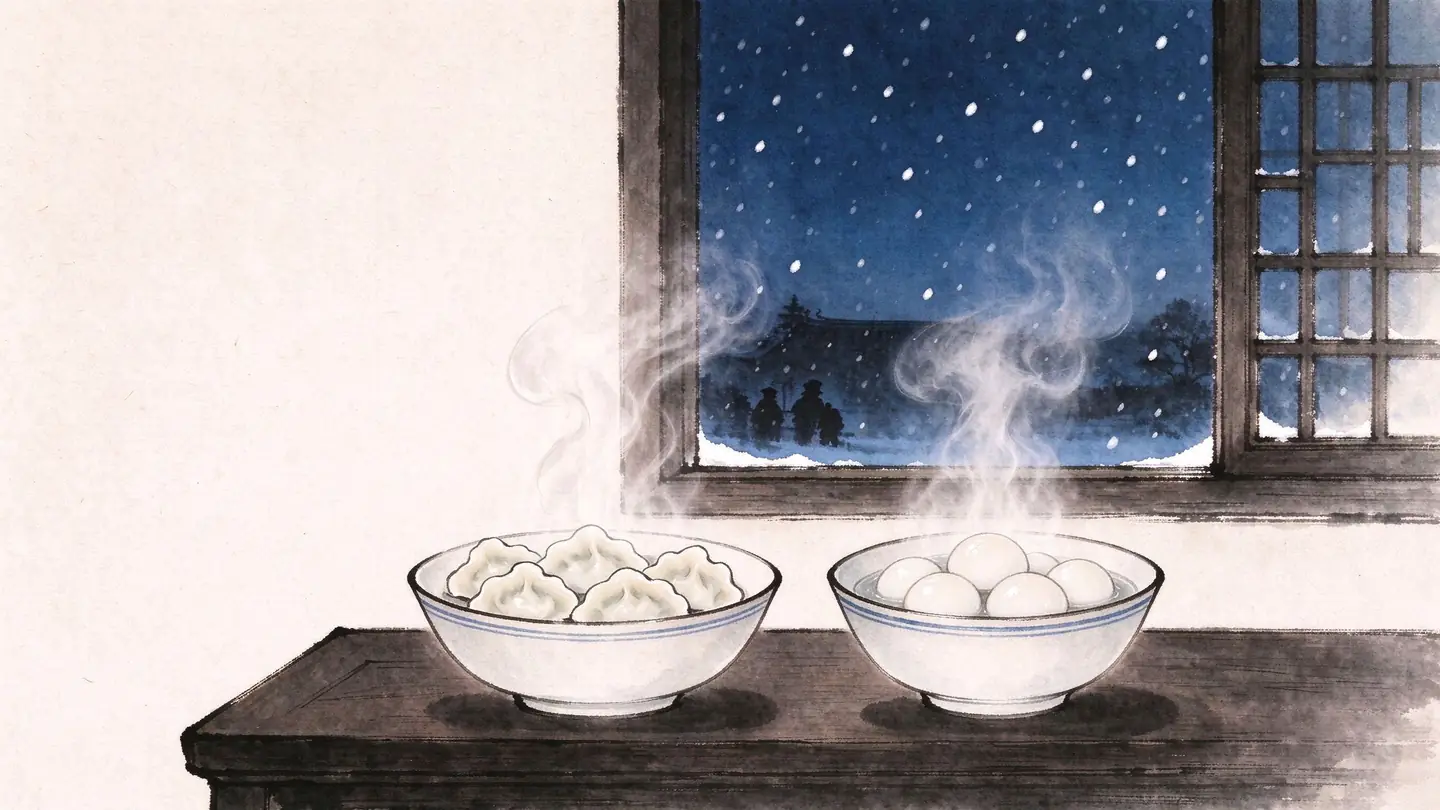
The story behind it Origin & legend
Winter Solstice is the oldest festival on this site and the only one measured with a sundial. By the Spring and Autumn period, 2,500 years ago, Chinese astronomers had already pinned down the exact moment using shadow lengths cast by the sun, and it became the first of the twenty-four solar terms to be fixed.
In the Zhou and Qin dynasties it was treated as the beginning of the year, and the emperor held a ceremony to heaven on this day. That is where the saying 冬至大如年 — 'the Winter Solstice is as important as the New Year' — comes from. In parts of the south it is still called 亚岁, 'second only to the New Year'.
Because the night is at its longest and the sun turns back, the festival's meaning is not really about cold. It is about the turning point: from here the days get longer. In the traditional understanding of yin and yang, this is the moment when yang is born out of maximum yin.
Today it is kept without a day off work. The reunion meal is eaten after office hours, pre-mixed dumpling fillings and frozen tangyuan sell out the day before, and northern mutton-soup restaurants take bookings a week ahead. In the south, the first bowl still goes to the ancestors before anyone sits down — a quieter survival of a festival that once outranked the New Year.
What it means Cultural significance
- The year turns here
- Not a celebration of winter but of the end of its growth. Every day after this one is a little longer. It is the quiet, optimistic counterpart to the summer solstice.
- The original family holiday
- Before Spring Festival existed in its current form, Dongzhi was the day the family gathered and the ancestors were fed. Much of what Spring Festival does now, Dongzhi did first.
- Health, stored not spent
- Winter is the season to conserve. The festival's food is heavy, warm and slow-cooked, and the advice is to sleep early and not to exhaust yourself. The tonic habit known as jinbu peaks on this night.
- A holiday China and its neighbours share
- Japan, Korea and Vietnam each mark a version of this day, a reminder that the solar-term calendar once spread well beyond China. In Japan it is the night for a kabocha pumpkin; in Korea, red bean porridge.
- Food as a badge, not just dinner
- Dumplings in the north and tangyuan in the south are rarely a free choice. What you eat on Winter Solstice says which family you come from, and many people keep the dish of their grandparents' province rather than of the city they live in now.
- A checkpoint through the cold
- The nine-nine countdown broke the coldest stretch of the year into nine manageable blocks. Its real job was psychological: it gave people a way to tick winter off rather than simply endure it, one small mark at a time.
Hour by hour A day in the festival
- Morning · the broth goes on
- Any slow soup — mutton, beef or chicken — is started early. In the north someone is also sent out for wrappers and mince if the family is making dumplings from scratch.
- Noon · an ordinary, light lunch
- The festival is about the evening, so lunch stays simple. There is no ritual to it; the day is being saved for the meal after dark.
- Afternoon · shopping and filling
- Shops sell pre-mixed dumpling fillings and trays of tangyuan. Glutinous rice flour, mutton and root vegetables go fast, and northern dumpling restaurants take their last bookings.
- Dusk · the family dinner
- The main event. In the south the ancestors are offered the first portion; elsewhere the family simply sits down together, in the same shape as a Spring Festival meal.
- Evening · the first stroke of the nines
- The 九九消寒图 is hung and its first petal, stroke or character is coloured in. From now a small mark goes onto the chart every day for eighty-one days.
- Night · a long, early sleep
- Traditional advice is to rest early on the longest night, protecting the yang energy just being born. Many people do the opposite of a party: they go to bed.
What people do Customs & activities
- The family dinner
- The main event, and structurally identical to the Spring Festival reunion meal — just without the fortnight of build-up. In the south, ancestors are offered food first.
- Eating dumplings in the north (吃饺子)
- The northern rule is absolute: dumplings on Winter Solstice. The legend is that Zhang Zhongjing, a Han dynasty physician, made dumplings shaped like ears filled with warm herbs to cure villagers with frostbitten ears — hence 'eating dumplings protects your ears'.
- Eating tangyuan in the south (吃汤圆)
- In Jiangnan, Fujian and Guangdong, the day calls for glutinous rice balls. Every family member eats an even number, for the round, whole, together meaning.
- The nine-nine cold chart (九九消寒图)
- A drawing made on the solstice with 81 petals, strokes or characters — one to be coloured in each day for the 81 days until spring. A winter calendar disguised as a picture, and a very good thing to give a child.
- Mutton soup and tonic food (羊肉汤 · 进补)
- In Sichuan, Shandong and the north, the day is for mutton soup and for the winter tonic custom, food deliberately rich and taken as medicine rather than for pleasure.
- Red bean porridge (红豆粥)
- In parts of the south, red beans are cooked into porridge on the solstice, a warming dish traditionally said to drive off evil spirits as well as the cold.
- Offering the first bowl (祭祖)
- In much of the south the solstice still includes the ancestors. Food is set out and a word said before the family eats — the one part of the day, some households say, that must not be skipped.
- Counting the nines (数九)
- From the solstice, families count nine periods of nine days. Each block is named in a short folk rhyme that tracks the falling temperature, and the count keeps going to the eighty-first day, when spring ploughing traditionally begins.
How it varies across China Regional differences
- North vs South: dumplings or tangyuan
- The clearest dividing line in the whole festival. The north eats dumplings and calls them ear-protectors, after the Zhang Zhongjing legend; the south eats round glutinous tangyuan for reunion. The line roughly follows the Huai River.
- The soup changes with the province
- Mutton soup dominates the north and northwest; Sichuan serves mutton too; Fujian and Taiwan favour ginger duck; and parts of the south cook red bean porridge against the cold. The evening meal, not the dish, is the constant.
- East China's other foods
- In Suzhou and parts of Jiangnan the day is also for a filled glutinous rice ball, and some households serve a bowl of noodles rather than tangyuan or dumplings. Several traditions coexist within one region.
- What the date depends on
- The solstice moment is a single instant in astronomy, but it lands on 21 or 22 December depending on the year. China keeps one national time zone, so the date is uniform from Harbin to Hainan.
- Overseas Chinese communities
- In Chinatowns in San Francisco, London and Sydney, the solstice is a family night rather than a street event. Restaurants sell out, but there is no public holiday, so most of it happens after work.
What to say — and what not to Greetings
- Say: 冬至快乐 or 冬至安康
- Both work. 冬至快乐 ('happy Winter Solstice') is the common, cheerful choice; 冬至安康 ('peace and health') is the softer register many people prefer for a day centred on warmth and health rather than on celebration.
- Say with the food: don't forget the dumplings
- In the north a reminder to eat is part of the greeting — 记得吃饺子, 'remember the dumplings'. In the south the same line switches to 记得吃汤圆, 'remember the tangyuan'. The food is the message.
- To whom: family, on the eve, and elders first
- Send it to parents and grandparents first, ideally the night before as well as on the day, since the reunion meal is the event. 冬至大如年 — 'as important as the New Year' — is the line that explains why it matters.
- If someone is far from home: mention the bowl
- For a friend who cannot get home, a short line works best: 'hope you get a bowl of tangyuan tonight'. It names the thing they are missing without turning the message heavy.
- Don't say: 'happy' where the day is for remembrance
- In a few southern regions the solstice is also kept for the ancestors, and 冬至安康 sits better there than 冬至快乐. If you are unsure of a family's custom, health and warmth are always the safe wish.
How to prepare Before the day
- Confirm the date before you plan anything
- It moves between 21 and 22 December depending on the year. Check the date at the top of this page rather than assuming.
- Decide dumplings or tangyuan, and commit
- It is a genuine north–south divide and there is no neutral option. Most families eat according to the region their grandparents came from, not where they live now.
- Shop a day early
- Dumpling wrappers and glutinous rice flour sell out in Chinese groceries on the day, and the queues at northern dumpling restaurants run for hours.
- Make the cold chart with children
- Print or draw the 九九消寒图 the night before so it can be started on the solstice itself. Daily colouring is a surprisingly effective countdown to spring.
- Buy for a slow, warm meal
- Mutton, beef, root vegetables, ginger, wine. The traditional menu is heavy on purpose — it is the one night of the year when that is the point.
- Plan an early night
- The festival's own advice is to rest. Going to bed early on the longest night is the most traditional thing you can do.
- Plan around a normal working day
- Winter Solstice is not a public holiday, so the whole festival has to fit around work. Decide in the morning who cooks, start any slow broth before you leave, or book a table early — restaurants fill up fast.
What not to do Taboos
- Do not eat cold food or skip the meal
- The whole point is warmth and food deliberately taken as medicine. A salad or a cold plate on Winter Solstice misses the festival entirely, whichever side of the country you are on.
- Do not stay up late or over-exercise
- Traditional health logic says yang energy is just being born and must be protected, not burned. This is the one night of the year when going to bed early is the correct celebration.
- Do not plan major exertion or an all-night party
- The same reasoning, applied socially: the energy just being born is meant to be rested, not spent. Winter Solstice is a quiet, indoor, family festival — not a party night, and not the evening for a long, loud gathering.
- Do not skip the ancestors if your family keeps the custom
- In the south, offerings come before the meal. Eating first is a small but real breach in households that observe it.
- Do not serve an odd number of tangyuan per person
- The round dumplings are eaten in even numbers, for the paired, complete meaning. One bowl with one in it is not the point.
- Do not give dumplings as a gift if unsure
- Unlike mooncakes, dumplings are not really a gift item. Turning up with a frozen bag of dumplings to an elder's home is more of a joke than a gesture.
- Do not turn it into a diet day
- The meal is deliberately rich because winter is the season to store, not spend. A light or skipped meal on the solstice runs against the whole idea of the winter tonic custom.
- Do not refuse the elder's bowl of soup
- If an elder presses mutton soup or tonic food on you, take some. It is offered as care rather than as food, and waving it away reads as rejecting the concern behind it.