
Double Ninth Festival
重阳节 · Chóng Yáng Jié
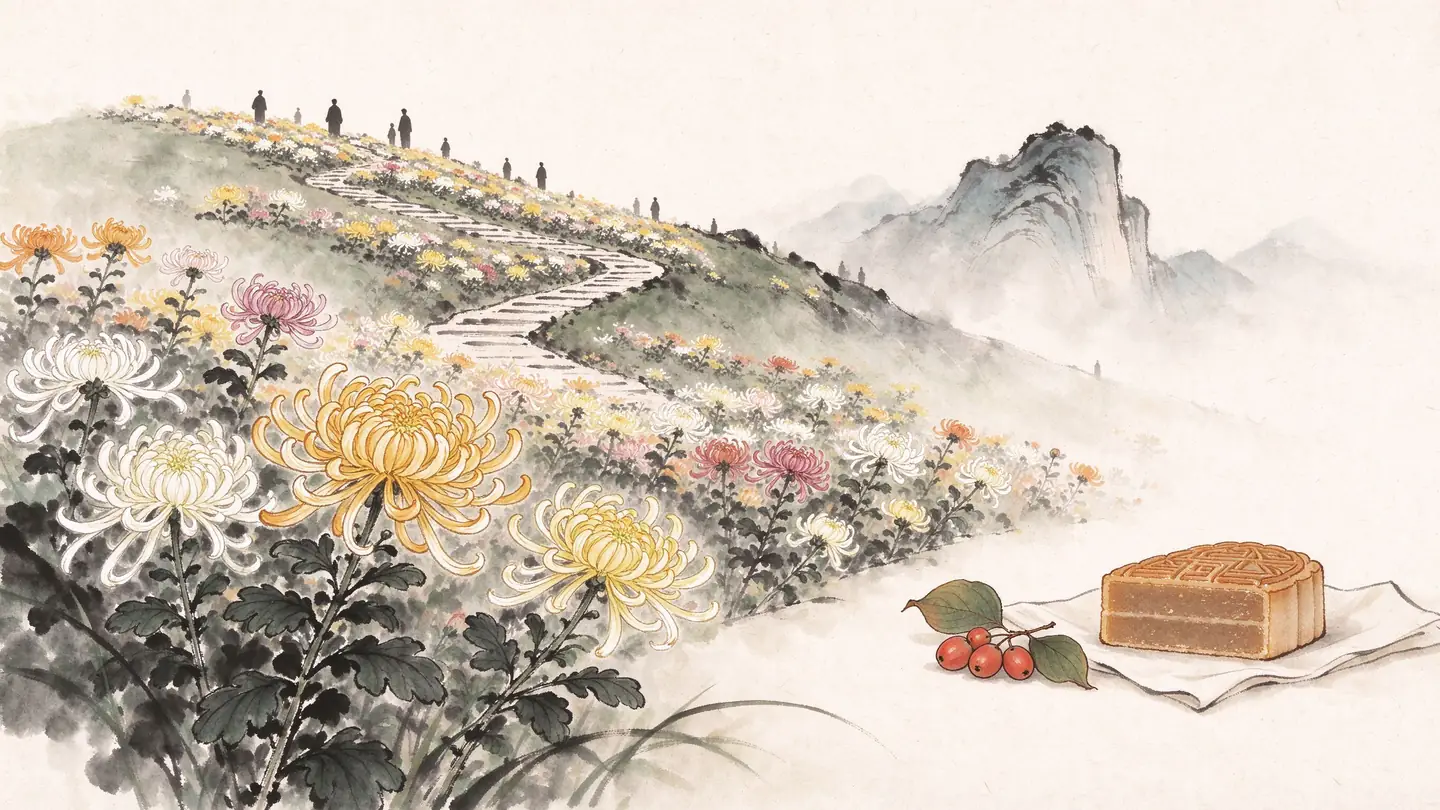
The story behind it Origin & legend
Nine is a yang number — the masculine, active, bright principle. The ninth day of the ninth month therefore carries a double dose of yang, which is why the festival is named 重阳, 'double yang'.
Its best-known legend is about a man called Huan Jing. A fortune-teller warned him that on the ninth day of the ninth month disaster would strike his village. He was told to take his family to high ground, wear a sprig of zhuyu (dogwood) on his arm, and drink chrysanthemum wine. They climbed the hill and stayed there until evening. When they came home, they found every animal in the village dead. The customs of climbing, wearing zhuyu and drinking chrysanthemum wine all come from that escape.
In 1989 the Chinese government designated the festival Senior Citizens' Day, converting an old luck-ritual into an official occasion for respecting the elderly.
Climbing also has a plain seasonal reason. The ninth month brings the clearest, coolest weather of the Chinese year, so the custom of going up a hill doubles as the best excuse of the autumn to be outdoors with family.
What it means Cultural significance
- Avoiding bad luck by going up
- The original logic: disaster travels along the ground, so you climb above it. The festival began as a survival ritual and turned into a picnic, and the direction of the movement is the whole idea.
- Longevity, celebrated out loud
- Chrysanthemum blooms in the ninth month and is the emblem of a long life. The dish of the day is a tall layered cake — 重阳糕, where 糕 sounds like 高, 'high' — so eating it is literally 'rising higher every year'.
- The one festival aimed at old people
- Since 1989 it has been an official day for visiting and honouring elders, which gives it a clear, modern, non-superstitious purpose and a practical thing that families can actually do together.
- Autumn's last good weekend
- Late October is the finest weather in most of China. Half the point of the festival is simply that the hills are worth climbing right now, before the cold and the short days arrive.
- A ritual that became a family obligation
- What began as a way to dodge bad luck on one dangerous day has turned into a standing appointment to visit the oldest generation. The superstition faded; the visit stayed, and it is the part that still does work.
- Chrysanthemum as the flower of endurance
- Chrysanthemum flowers late, when almost everything else is gone, which is why it came to mean endurance in old age. Wearing it, drinking it and giving it on this day all say the same thing in different ways.
Hour by hour A day in the festival
- Morning · cake and a sprig of dogwood
- Breakfast often includes a piece of double-ninth cake, and some people pin a sprig of zhuyu, the pungent red dogwood berry, to a sleeve or pouch exactly as their ancestors did on the same day.
- Late morning · set out for the hill
- Families leave for a nearby hill, temple or hilltop park before the crowds build. Popular mountains on the ninth fill early, so many start climbing by mid-morning.
- Midday · the top, and the view
- The point of the climb is reached at the summit: to look far, rest and eat what was carried up. Chrysanthemum tea is passed round, and older relatives often take the cable car to meet the rest.
- Afternoon · the visit to the elders
- Back down, many families go straight to a grandparent's or an elderly neighbour's home with fruit, tea or warm clothing. This visit, more than the climb, is what the modern festival is really for.
- Evening · chrysanthemum wine at the table
- Dinner may include chrysanthemum wine or tea, and in some regions crab or mutton. The drink is taken for health and a clear head in the cooling season, not as a celebration.
- Night · the chrysanthemum display
- In many cities the ninth month brings chrysanthemum shows in parks, and families walk through them after dinner. It is the festival's last and quietest act, and often its most photographed.
What people do Customs & activities
- Climbing a hill (登高)
- The central act. Not a hike for the sake of exercise — the point is to be literally above the danger, and to see far. The view from the top is the reward the old ritual promised.
- Drinking chrysanthemum wine or tea (菊花酒)
- Chrysanthemum is believed to clear the head and ward off autumn illness. Tea is the modern, alcohol-free version, and in either form the drink is taken for health rather than for a toast.
- Wearing a sprig of zhuyu (佩茱萸)
- Dogwood, a pungent red berry, worn pinned to the sleeve or carried in a small pouch. It is an insect repellent with a talismanic reputation, doing practical work behind the ritual.
- Eating double-ninth cake (吃重阳糕)
- A tall steamed cake, often nine layers, decorated with little paper flags. Some families put one on a child's forehead, saying 步步高, 'step by step, higher', as a blessing for the year.
- Honouring the elderly
- Visiting grandparents, bringing them gifts, taking them out. Many communities hold group outings for retired residents on this day, and the visit is the part of the festival that still matters most.
- Admiring the chrysanthemums
- Chrysanthemum shows are held in parks across the country in the ninth month. It is the flower's season and the festival's signature image, and the shows are usually free to walk through.
- Sending elder-care gifts
- Warm clothing, tea, a health tonic or fruit are the standard gifts, brought in even numbers. For relatives far away, a delivered box or a call on the ninth counts as doing the custom properly rather than substituting for it.
- Visiting a chrysanthemum show
- Parks across the country stage chrysanthemum displays in the ninth month, and the show is often the easiest way to mark the day without climbing anything. It is a common outing for older relatives.
How it varies across China Regional differences
- North vs South: what is eaten on the ninth
- The north leans on the layered double-ninth cake and mutton, both suited to cooler weather. The south has its own cakes and, along the coast, crab at its autumn best. Each region treats its own version as the real one.
- Which hill, and how high
- Near Beijing people climb Fragrant Hills; around the Yangtze delta, low hills and pagodas; in the south, whatever ridge is within reach. The custom needs altitude of some kind, and every region defines it locally.
- Chrysanthemum shows, region by region
- Cities with a strong chrysanthemum tradition, from Kaifeng to Guangzhou, stage large autumn shows, while elsewhere the flower is simply bought for the home. The show is a recent public version of an old private custom.
- How the elderly are honoured in practice
- Some communities organise group outings for retired residents; many families keep it to a private visit and a delivered gift. Urban households with relatives far away increasingly send a courier box and a video call.
- How it changes overseas
- Overseas, the climb is replaced by a hill walk or a park visit on the nearest weekend, and the elder-care visit becomes a phone call. The cake is often bought in a Chinese bakery rather than made at home.
What to say — and what not to Greetings
- Say: 重阳安康 or 平安健康
- Because the festival began as a ritual to escape disaster, the traditional greeting is about safety and health rather than festivity. 重阳安康 ('peace and health at Double Ninth') and 平安健康 both fit the day well.
- Don't say: 重阳快乐 out of habit
- 'Happy Double Ninth' is not offensive, but it misses the point. For an older relative the greeting is expected to be about wellbeing; leading with 快乐 to a grandparent can sound like you have not thought about the day.
- To elders: wish them longevity, plainly
- For parents and grandparents, 健康长寿 ('health and long life') or 岁岁平安 ('peace year after year') is the register the day was built for. Long life is the festival's actual theme, so the wish can never be too much.
- To peers: a light wish to climb more
- Between friends, 重阳安康 plus a joke about who is climbing what works well. A line such as 'go up a hill and call your grandmother' carries the day's two duties in a single breath.
- If you are far from your elders: a call is the greeting
- On this day the visit is the point, so a real phone or video call to the oldest relatives matters more than any text. Say the wish out loud, ask about their health, and let them do most of the talking.
How to prepare Before the day
- Plan the climb around the weather and the crowds
- The ninth day falls in the middle of China's best autumn weather, and popular mountains are genuinely packed. Go early or go on the weekend either side to avoid the crush.
- Call the elders before the day
- The point of the festival is the visit. If you cannot be there, a call on the ninth is the whole gesture — and for many families it is the reason the holiday exists at all.
- Buy chrysanthemums in the right colour
- Yellow and deep red are festive and are what you bring to a home. White chrysanthemums mean mourning, so check the colour before you carry a bunch up to anyone's door.
- Make or buy double-ninth cake
- Steamed rice-flour cake with layers of red bean, jujube or chestnut. It is straightforward to make and a good thing to prepare with children, who enjoy the layers and the little flags.
- Prepare a gift for grandparents
- Warm clothing, tea, a health tonic, or fruit. Bring something, and bring it in even numbers; for distant relatives, check the delivery will arrive before the ninth rather than after.
- Book transport and pack a picnic for the top
- If you are climbing, pack water, warm layers and something to eat at the summit, and check the weather the night before. Many families now drive to a hilltop park rather than walk up, which suits older visitors better.
What not to do Taboos
- Never gift white chrysanthemums to anyone
- The important one. In Chinese funerary custom, white and pale yellow chrysanthemums belong to mourning. The festival flower is fine to admire, but bringing white chrysanthemums as a gift — especially to an elderly person — is a serious mistake.
- Do not say "happy Double Ninth" out of habit
- Because the festival began as a disaster-avoidance ritual, the traditional greeting is about safety and health — 重阳安康, or 平安健康 — rather than 重阳快乐. The festive register misses the point of the day.
- Do not trigger the word 九 in bad contexts
- 九 sounds like 久 (long-lasting), which is why the day is auspicious for longevity. Avoid pairing it with anything you would not want to last, and the number will work for you rather than against you.
- Do not visit elders empty-handed
- Arriving with nothing is a real breach on a day explicitly set aside for them. Even a small, thoughtful gift is enough; the offence is in the emptiness, not the price.
- Do not climb carelessly or rush
- The custom is old and the mountains are crowded. Every year brings reports of falls by older people who insisted on the summit, so choose a route that suits the eldest person in the group.
- Do not send flowers you have not thought about
- Beyond chrysanthemums, avoid white lilies and white roses in the same way. The general rule is that white blooms carry funerary meaning in Chinese gift culture, whatever the occasion.
- Do not overlook the elders who live alone
- The festival's official purpose is honouring the old, and the ones easiest to miss are neighbours and relatives who live alone. A visit or a call to them is closer to the day's intent than any elaborate ritual.
- Do not give a gift that implies frailty
- Bring warmth and good food, not anything that reads as 'for the very old' — a walking frame or a hospital-oriented gift lands as a comment on their health. Choose gifts for pleasure and comfort instead.