Lantern Festival
元宵节 · Yuán Xiāo Jié
The story behind it Origin & legend
Lantern Festival closes the fifteen-day Spring Festival period and is around 2,000 years old. It began in the Han dynasty, when the court lit lamps through the night to honour the moon, and later to worship the Buddha.
One popular story credits Emperor Ming (r. 57–75 AD), a patron of Buddhism, who ordered the palace and the temples to light lanterns on the fifteenth night so that ordinary people could join in. From palace ritual it spread to the street, and from the street it became a folk festival of light.
Over the following centuries the palace lamps turned into public lantern fairs, and the fifteenth night became the one evening when the old city curfews were relaxed so that rich and poor could walk the streets after dark. Riddles written on the lanterns turned the fair into a contest of wits, and the whole night became the busiest of the year for matchmaking as well as for looking at lanterns.
Today the festival is still the full stop at the end of the New Year holiday. Cities build large lantern displays — Nanjing's Qinhuai fair is the best known, and Zigong in Sichuan builds scenes several storeys high — and the fifteenth is the last day that greetings and family dinners still belong to the New Year.
What it means Cultural significance
- Light against the dark
- The lanterns mark the first full moon of the lunar year. Fire and light are meant to drive out winter darkness and whatever hides in it.
- Reunion, one last time
- The round shape of the moon, the lanterns and the rice balls all say the same word: 圆 — round, whole, together. After tonight everyone disperses again.
- A festival made for wandering
- Historically this was one of the few nights when young women could leave the house unchaperoned, which is why so much classical poetry sets romance on the fifteenth night.
- A night decided by riddles
- Lantern riddles are not decoration. Writing a good one is a recognised literary skill, and a clever riddle lets you show off in public without saying a word about yourself.
- Ending the season on purpose
- The festival is the full stop on a fifteen-day holiday that began with the New Year. One last feast and one last reunion give the season a clear end, which is why work and school can restart the next morning.
- When the lights became the people's
- In its Han form the lighting was state ritual, first the emperor's, then the temples'. Once the lamps moved into the streets, ordinary families owned the night — and the festival became genuinely popular.
Hour by hour A day in the festival
- Morning · the last day of the holiday
- The fifteenth is the final day of the Spring Festival period, so the morning is quiet — leftovers are finished and children count their red-envelope money.
- Afternoon · making or buying tangyuan
- Filling is prepared, or trays are bought from shops that sell them for only a few days. Cooking the round balls is the first ritual of the evening.
- Dusk · lanterns go up and out
- Door lanterns are lit and families head to the nearest lantern fair or old street. By full dark the displays are at their brightest.
- Evening · the fair and the riddles
- Crowds read riddles pasted on the lanterns and queue for sugar-figure makers and snacks. Children carry small lanterns of their own, usually battery-lit.
- Around 9 pm · the full moon
- The first full moon of the lunar year rises highest around this time; families stop to look at it, and the pictures go straight into the group chat.
- Late evening · the last bowl
- Back home, a bowl of tangyuan is eaten together, in even numbers, and the pot is finished rather than left. In water towns, small lanterns are set afloat with a wish.
- Past midnight · the season ends
- The dinner is over and the fifteen-day holiday is over with it; the streets empty and work resumes the next morning.
What people do Customs & activities
- Lantern displays (灯会)
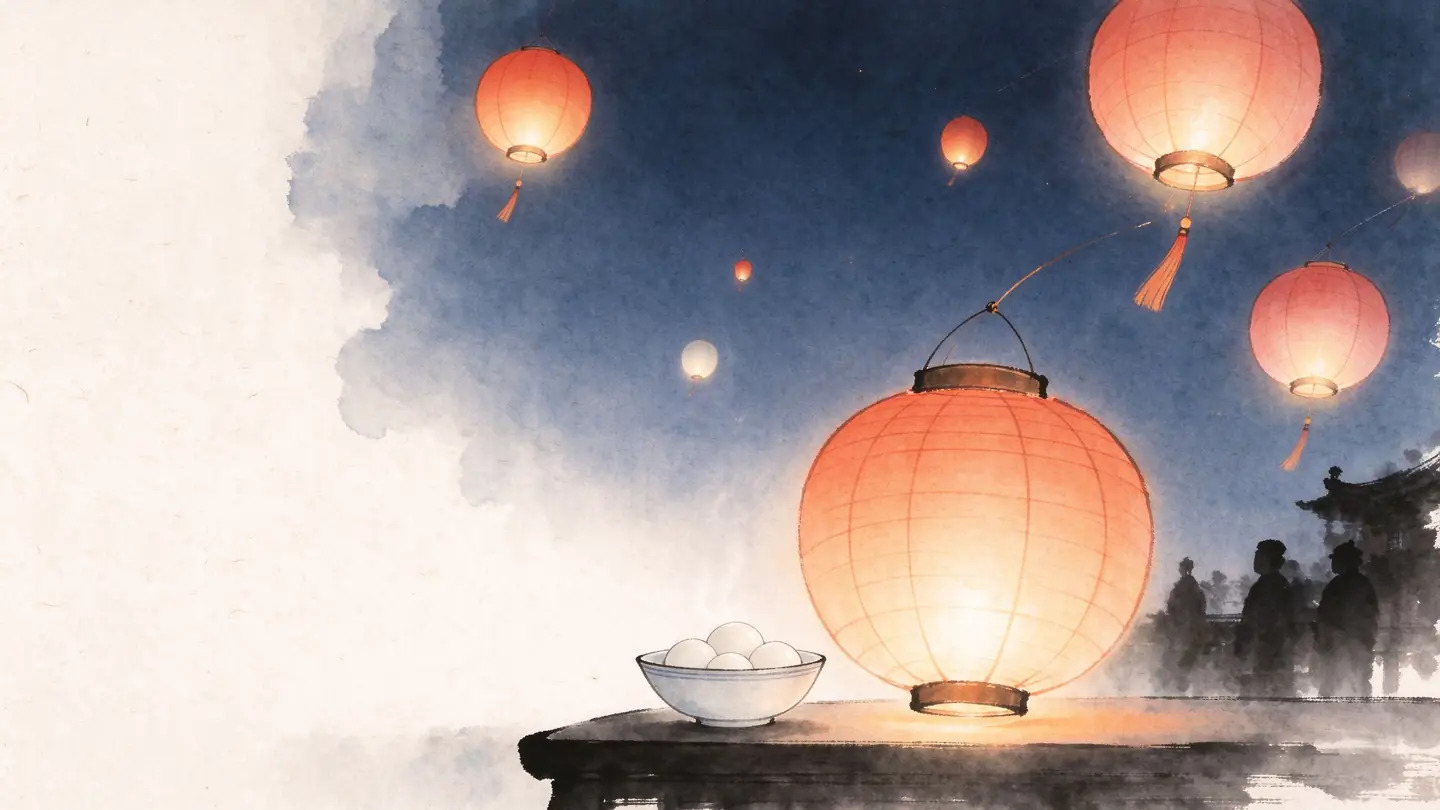
- Parks and old streets fill with illuminated silk lanterns — dragons, palaces, animals and whole scenes from mythology, lit from dusk until late.
- Lantern riddles (猜灯谜)
- A riddle is pasted on each lantern. Solve it, take the prize. Many riddles turn on how a Chinese character is built, so the answer is often the word's own shape.
- Eating tangyuan or yuanxiao (汤圆 · 元宵)
- Round glutinous rice dumplings, boiled, in soup. In the north they are rolled; in the south they are wrapped around the filling. The name is practical: tāngyuán sounds like 团圆, reunion.
- Dragon and lion dances
- Tonight they are at their most elaborate, often ending with a firework finale and a drum line that draws the whole street.
- Floating river lanterns
- In water towns, small paper lanterns are set afloat carrying a wish. It is the quieter, southern counterpart to the fair.
- Walking the bridges (走百病)
- In the north, people — historically, mostly women — walk across bridges on the fifteenth and sixteenth nights, believing the walk "walks off a hundred illnesses". The more bridges, the better the year.
- Watching the first full moon
- The fifteenth night is the first full moon of the lunar year. Families step outside to look at it, and photographs of the moon go into group chats.
How it varies across China Regional differences
- North vs South: yuanxiao or tangyuan
- In the north the balls are rolled in dry flour around a hard filling and called yuanxiao; in the south they are wrapped by hand around a soft one and called tangyuan. Families on both sides consider theirs the real thing.
- Where the biggest fairs are
- Nanjing's Qinhuai lantern fair is the best known and draws crowds for weeks; Zigong, in Sichuan, is famous for lantern scenes several storeys high. Smaller towns hold theirs in a single park or temple.
- Who eats what instead
- In parts of the far north and northeast, dumplings are eaten on the fifteenth rather than sweet balls, while some southern cities keep the balls sweet and add savoury side dishes. Neither replaces the other.
- How it changes overseas
- In overseas Chinese communities the Lantern Festival is often the largest street event of the year, with a parade, lion dance and food stalls — usually on the nearest weekend, since the date itself is a working day.
- Bridges in the north, lanterns in the south
- The custom of walking across bridges to shed illness is strongest in the north; in the south, floating river lanterns and their wishes take its place.
What to say — and what not to Greetings
- Say: 元宵快乐 or 元宵安康
- "Happy Lantern Festival" works, but 安康 — "peace and health" — is the calmer choice many families prefer. It is the last night of the New Year period, so the wishes still run to family and good fortune.
- Say: 团团圆圆 — reunion above all
- A common blessing wishes the family "round and whole". It fits the food (round balls) and the moon (full) at once, so it is never wrong on this night.
- Don't say: a festive greeting to a family in mourning
- As with the rest of the New Year period, a household that lost someone in the past year may not celebrate. A quiet 保重 — "take care" — is safer than any festival greeting.
- To whom: the last family greeting of the year
- If you are far from home, the fifteenth is the deadline to call the oldest relatives; after this night the greetings stop until next year, which is why a late call is better than none.
- With the food: pass it, don't count it
- When you serve tangyuan, hand over an even number and never a single one. If you want to add something, a sweet word matters less than the count — the count is the blessing.
How to prepare Before the day
- Buy lanterns a week ahead
- Simple ones for children to carry, larger ones for the door. Battery candles are safer than real ones and are what most families use now.
- Stock glutinous rice flour and filling
- Black sesame, red bean or peanut. Homemade tangyuan is a family activity, not just a dessert, and the flour sells out in the days before.
- Prepare a few riddles
- If you are hosting, write five or ten riddles in advance with small prizes. It is what makes the night for children.
- Check your city's Chinatown parade
- Lantern Festival is the biggest street event of the year in most overseas Chinese communities — often bigger than New Year's Day itself.
- Plan the route, and the last train
- Lantern fairs draw their largest crowds of the year. Underground stations near the big displays are closed or exit-only, so check the route home before the crowds peak.
- Decide the sweet or savoury fillings
- Buy the filling the day before and chill it: rolled northern yuanxiao need a firm centre, wrapped southern tangyuan a soft one. Getting the texture wrong is the usual first-year mistake.
What not to do Taboos
- Do not break or drop a lantern
- The lantern stands for the year's light and fortune. Breaking one is considered a bad sign, especially if a child is carrying it.
- Avoid black and white clothing
- These are the colours of mourning. Red, gold or bright colours are the point of the evening.
- Do not lend money today
- Same logic as Spring Festival — the fifteenth still belongs to the New Year period, and money lent now is fortune lent out.
- Do not cry or let a child cry
- It is the last night of the New Year celebrations; tears are believed to spoil the whole fortnight.
- Do not pay the New Year's debts late
- There is a folk saying that debts should be settled before the Lantern Festival. Leaving them open is thought to mean a year of owing.
- Do not let the door lantern go out
- The lantern kept at the door stands for the year's light; in many homes it is left burning through the night, and refilled or replaced rather than allowed to die on the last night of the holiday.
- Do not serve an odd or single tangyuan
- The balls are served in pairs or even numbers, and the pot is finished rather than left half-empty. The round, whole shape is the meaning, so a lonely single ball defeats it.