
Qixi Festival
七夕节 · Qī Xī Jié
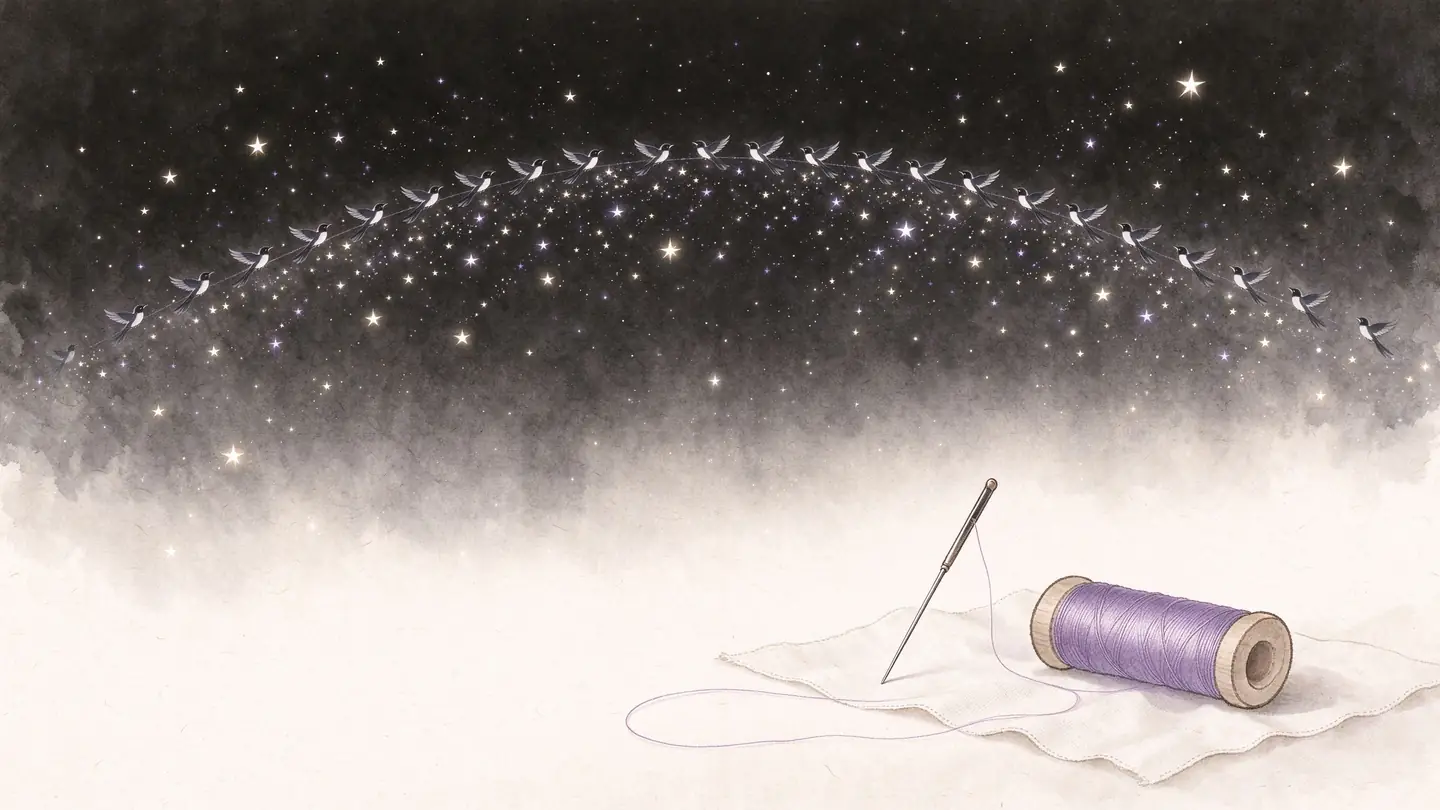
The story behind it Origin & legend
Look up on the seventh night of the seventh lunar month and the festival's whole plot is overhead: Vega (the Weaver Girl, 织女) and Altair (the Cowherd, 牛郎), separated by the white band of the Milky Way.
In the story, Zhinü was a heavenly weaver who came down to bathe and fell in love with a mortal cowherd. They married and had two children. The Queen Mother of the West, furious that a goddess had married a man, dragged Zhinü back to the sky and scratched the Milky Way between them with her hairpin. The couple are allowed to meet once a year, on the seventh night of the seventh month, when magpies form a bridge across the river with their bodies. If it rains that night, it is said to be their tears.
The festival has been many things. For most of its history it belonged to girls and young women, not couples: the seventh night was when they gathered to pray for skill in needlework and to compare their handicrafts. That older festival nearly disappeared in the twentieth century, when arranged marriages and home weaving faded, and retailers and social media rebuilt it from the 2000s as a Chinese Valentine's Day.
None of this is invented by the calendar. Vega and Altair are both first-magnitude stars, brightest in the northern summer, and the Milky Way really does lie between them. The two are already a couple in the oldest poetry that survives, a poem in the Classic of Poetry some 2,600 years old.
What it means Cultural significance
- Fidelity kept across a distance
- What is celebrated is not passion but endurance: two people who keep a promise for 364 days of the year. For the many who work in a different city from the person they love, this is the festival's real centre.
- Originally a festival for women, about skill
- The older name 乞巧 means 'begging for skill'. Girls gathered to pray to Zhinü for proficiency in needlework, put a needle on the surface of water and read the shadow it cast, and threaded nine needles by moonlight.
- The one festival with a scientific date
- Vega and Altair are genuinely at their highest and brightest in the northern summer sky in August. The festival is astronomy with a love story attached, and the astronomy came first.
- Quietly commercialised since the 2000s
- Since the 2000s Qixi has been rebuilt by retailers and social media as a Chinese Valentine's Day, which is why couples now dominate a festival that used to belong to girls and craft.
- Distance as the theme, not diamonds
- The two stars meet once a year, so what the story honours is patience across separation. The festival's emotional centre is endurance, which is a harder and less marketable thing than romance.
- Craft, competition and friendship between women
- The older festival was a night of handicraft contests and gift exchanges among friends, not a dinner for two. Keeping that half in view makes the modern Valentine's framing look like a late and partial rewrite.
Hour by hour A day in the festival
- Afternoon · set the table for the stars
- Fruit, melon and a bowl of clear water are laid out under the open sky, along with a needle and thread. The table is set before dark so that nothing is arranged in a hurry.
- Dusk · the first and brightest star
- Vega is usually the first star visible, almost overhead in August. Families point it out to children and name it 织女星, the Weaver Girl, as the night's opening act.
- After dark · the needle contest
- Girls thread a needle by moonlight, or drop one onto a bowl of water and read the shadow it casts. A shadow like a flower or a cloud is read as skill granted for the year.
- Later · exchanging handmade gifts
- Friends and couples give what they have made — embroidery, a paper cut, a woven bracelet. The gift is judged on the work in it, which is the older and stricter rule.
- Night · lanterns and wishes
- Wishes for a good marriage, a skill or a friend are written on paper lanterns and floated on water or hung under the eaves. In cities the floats are often part of a public event.
- Late · looking for the bridge
- The pair are said to meet at midnight, with magpies forming a bridge. Children are told to watch for the birds; on a clear night the Milky Way is the only bridge anyone actually sees.
What people do Customs & activities
- Stargazing the two stars (观星)
- Find Vega overhead and Altair across the Milky Way. In China the two stars are known simply as 牛郎星 and 织女星, and pointing them out is the whole opening move of the night.
- Making and giving handmade gifts
- The traditional gift here is something you made — embroidery, a paper cut, a woven bracelet — not something you bought. The gift is judged on the work in it, which is the older rule of the festival.
- Offering fruit and melon to the stars (乞巧)
- Girls laid out fruit, melon and flowers under the moon and prayed for skill, usually in needlework and cooking. The rite needs only a table, a bowl of water and open sky.
- Floating lanterns and paper boats
- Wishes for good marriages, a skill mastered or a friend found were written on lanterns and set on water, letting the night carry the request away rather than keeping it.
- Eating qiaoguo (巧果)
- Small fried pastries in the shape of flowers and animals, threaded on red string and hung up. They are as much decoration as food, and half the fun is in the shapes.
- Threading a needle under moonlight (穿针乞巧)
- The original contest of the night: seven needles in a row, one thread, moonlight only. A steady hand and sharp eyes won the round, and the finished pieces were traded as gifts.
- The water-shadow test (投针验巧)
- Girls dropped a needle onto the surface of a bowl of water set in moonlight and read the shadow it threw. A shadow shaped like a flower or cloud meant skill was granted.
- Washing hair in seven-flower water
- In parts of Guangdong and Guangxi, girls and women washed their hair on the seventh night in water steeped with seven kinds of flower, a custom believed to bring beauty and good fortune for the year ahead.
- Writing wishes for the year
- A wish for a good marriage, a mastered craft or a found friend was written on paper and hung under the eaves. Unlike a new year wish, this one is addressed to two stars rather than to the household.
How it varies across China Regional differences
- North vs South: what the girls did
- In the north the emphasis fell on needlework — threading and shadow-reading. In the south, especially Guangdong and Guangxi, the rite centred on water: washing hair in seven-flower water and floating lanterns on a river.
- Rural craft tradition vs city romance
- In farming regions the festival still reads as a night of handicraft and courtship among neighbours. In big cities it has become a restaurant and gift holiday, and the needle contest is now a novelty.
- The one night women ran the ceremony
- Region to region the officiants were the same: girls and young women, who led the prayers and the contests. Men were largely spectators, which is unusual in a calendar of mostly household or public rites.
- How it changes overseas
- Overseas Chinese communities stage smaller Qixi events — craft markets, lantern floats and stargazing nights. With no public holiday, the observance usually moves to the nearest weekend.
- The same stars across East Asia
- Japan's Tanabata and Korea's Chilseok mark the same two stars on different dates, using a solar and a lunar calendar respectively. The sky is shared; the timing is not.
What to say — and what not to Greetings
- Say: 七夕快乐 to friends and couples
- Qīxī kuàilè — 'happy Qixi'. Unlike the memorial festivals, this is a light, warm occasion, so a happy greeting is fine. Between close friends a joke about 'finding your magpie bridge' lands well.
- To a couple: keep it about the two of them
- For people in a relationship, a plain 'happy Qixi to you both' works better than anything clever; add a wish that they see each other soon and often. The story is about a long-distance pair, so patience-themed lines land.
- Don't say: greetings that pressure single people
- Asking a single friend when they will marry, or 'when is your turn', turns a festival into pressure. In Chinese social life this is the classic off-note; keep the greeting about the day, not their status.
- To older relatives: wish the family well
- With grandparents and parents, 七夕快乐 can feel too romantic. A simple wish for health and family harmony — 阖家安康 ('peace and health to the whole family') — reads better and is never out of place.
- In a message: one warm line, no essay
- A short line that nods to the older, skill-based festival — 'happy Qixi; may you master whatever craft you have your eye on' — dodges the commercial cliché, and a Chinese friend will notice and appreciate the reference.
How to prepare Before the day
- Check moonrise and the sky
- A dark-sky spot outside the city, or a rooftop away from streetlights. Binoculars make Vega and Altair unforgettable, and August is the easiest month of the year to see them.
- Learn the two stars before you go
- Vega is the bright blue-white star almost overhead; Altair is the one flanked by two small stars across the pale band of the Milky Way. It takes about sixty seconds to learn.
- Make something, don't buy something
- The traditional gift is handmade — a written letter, a hand-bound notebook, a paper cut. It fits the festival better than a shop-bought gift, and it is much harder to fake.
- Book dinner early, well ahead
- If you are marking it as a couples' night, note that Qixi is now one of the busiest restaurant nights of the Chinese year. The good tables go a week or more ahead.
- If you are in a Chinatown, ask about the festival
- Some communities stage Qixi events — needle-threading contests, lantern floats, craft markets. Schedules are rarely widely advertised, so asking locally is the practical move.
- Set a small table for the stars
- The old rite needs only a bowl of water, a needle and a plate of fruit and melon set out under the open sky. It is a home ritual anyone can copy, with no temple or purchase required.
- Check whether it is a rainy seventh
- If the night turns wet, tradition says the couple is weeping, and some families move the whole rite indoors. Weather also decides whether you will see Vega at all, so keep a backup plan.
What not to do Taboos
- Do not give clocks, knives or scissors
- Clocks sound like attending a funeral, and cutting tools symbolically sever a relationship. Blades are also a pointed gift in the literal sense, which is the second reason to avoid them.
- Do not give an umbrella (伞)
- It sounds like 散 — to scatter, to break up. Giving an umbrella to a partner is the classic unlucky gift, and the prohibition holds whether the umbrella is cheap or expensive.
- Do not give shoes (鞋)
- Sounds like 邪 (evil) and, in the context of couples, is also read as 'walking away'. Even a very good pair of shoes is the wrong present on a day about staying together.
- Do not give or share a pear (梨)
- 梨 sounds like 离 — separation. In particular, never split one pear between two people as a gift; the point of the day is the opposite of what that gesture says.
- Do not move house or start a wedding on this day
- The old almanacs mark the seventh of the seventh as inauspicious for a marriage, precisely because the story ends in separation for most of the year. A modern irony worth knowing.
- Do not focus only on the couple
- The older, better version of the festival is about skill and friendship. Girls would swap handicrafts with close friends, and ignoring that half leaves out most of the festival's history.
- Do not give flowers in an odd number
- Bouquets are given in even numbers, and a single bloom or an odd count carries different meanings in Chinese gift culture. The number matters almost as much as the flower you choose.
- Do not test a relationship by the day's signs
- Rain read as weeping, or a marriage avoided because of the date, is folklore rather than fate. The day works best as a light custom to enjoy, not a verdict to fear.