
Shangsi Festival
上巳节 · Shàng Sì Jié
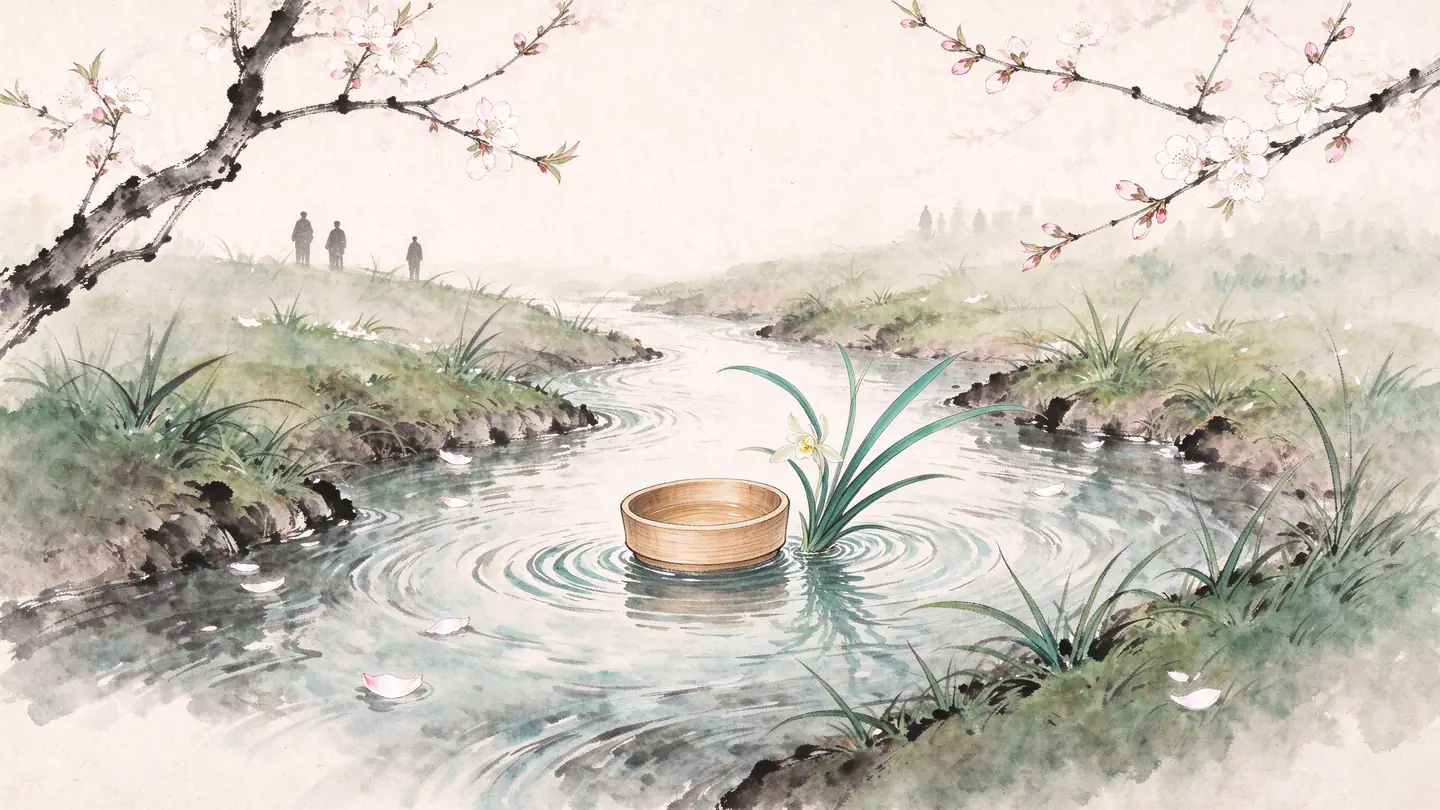
The story behind it Origin & legend
Shangsi is one of the oldest festivals in China. It was held in the third lunar month and, in its earliest form, on the first 巳 (sì) day of that month — the name simply means "the first sì". The day was later fixed to the third day of the third month, which is how it is kept today.
Its original rite was 祓禊 (fúxì), a purification bath in running water, meant to wash away the previous year's bad luck and illness before the farming year began. The Book of Songs, compiled around the 6th century BC, already describes young men and women gathering by the rivers Zheng and Wei on this spring day.
By the Eastern Jin the washing had grown into a literary picnic. In 353 AD the calligrapher Wang Xizhi and about forty friends met at the Orchid Pavilion near Shaoxing and played 曲水流觞 — setting wine cups adrift on a winding stream and composing a poem before a cup reached the drinker. The preface Wang wrote for their book of poems, the Lantingji Xu, became the most admired piece of Chinese calligraphy ever written, and it came out of a Shangsi gathering.
As a national festival Shangsi faded after the Tang, and its spring-outing half was slowly absorbed into Qingming — but it never vanished. In Guangxi it survives as the Zhuang song festival, 三月三, now a public holiday in the region; elsewhere it lives on in local washing and blossom customs, and in the many poems written about the third of the third month.
What it means Cultural significance
- A ritual cleansing turned into an outing
- The original purpose was purification — washing away the previous year's bad luck in running water — which in time became a spring picnic by the river.
- Spring as a fresh start
- The festival is pinned to the first warm weeks of the year. The purification was not really about dirt but about the year's fortune: to open the growing season clean, you began by washing.
- A rare day for women and children
- On most days of the old calendar, women's movement outside the house was limited. Shangsi was a licensed exception — a day at the water, in the open air. This is why so much spring poetry is set on the third of the third month.
- A day for poetry and display
- The floating-cup game turned an outing into a contest of wit: you had to compose a line before the cup reached you. It gave the educated a public stage, and gave the festival its most famous image.
- Water as the line between the years
- In a farming society, rivers marked the turn from the cold, closed half of the year to the open one. Entering the water on the third day was entering spring.
- The festival that lent its day to Qingming
- Shangsi's outdoor half — the spring walk, the blossom, the kite — was gradually merged into Qingming, which is why the two feel like close relatives and why Shangsi survives best where the old customs were kept apart.
Hour by hour A day in the festival
- Morning · to the water
- People head to rivers, lakes and parks early in the morning, following the festival's long association with fresh spring water and open air.
- Mid-morning · the symbolic wash
- Where the old rite is kept, hands are washed or a basin of water is set with a herb sprig; the point is to start spring clean, not to swim.
- Noon · the picnic on the bank
- Families spread food on the grass — eggs cooked with spring greens, cold dishes, wine. Eating outdoors is the heart of the modern festival.
- Afternoon · blossom and the first green
- The third of the third month sits in peak blossom season. Walks follow the trees, and children gather willow and early flowers.
- Late afternoon · floating cups and songs
- At a few parks and calligraphy events the old 曲水流觞 is staged; in Guangxi the afternoon belongs to antiphonal singing instead.
- Dusk · home with spring plants
- The early cool ends the day. Willow and herbs brought back are put in water or at the door, and the picnic basket is emptied.
What people do Customs & activities
- Spring outings by the water (踏青)
- Families walk beside rivers and lakes, a custom that grew directly out of the ancient bathing ritual; the walk itself is now meant to be the rite, carried out on dry land.
- Ritual washing (祓禊)
- The original act: bathing or washing at a river or spring to shed the previous year's bad fortune. In its softened modern form it is a walk to the water and a symbolic wash of the hands.
- The floating-cup game (曲水流觞)
- Cups of wine are set adrift on a winding channel; whoever a cup stops in front of must compose a poem or drink a penalty. Revived today at a handful of parks and calligraphy events.
- Gathering and wearing spring plants
- Orchids, peonies and willow are picked and worn; in some regions a bath scented with herbs — a 兰汤 — was part of the day. The bouquet was the point as much as the water.
- Singing and antiphonal songs (对歌)
- In Guangxi the Zhuang festival is built around sung exchanges between groups. It is the loudest surviving form of Shangsi, complete with five-colour sticky rice.
- Eggs and spring greens
- In parts of Hunan and Hubei, families cook eggs with shepherd's purse (地菜) picked that day; the dish is a folk remedy and a spring ritual in one.
- Games in the open air
- Swings, kites and, historically, the old ball game cuju belonged to the festival, and the point was simply to be outdoors after a long, closed winter.
How it varies across China Regional differences
- Where it is still a festival
- As a national holiday Shangsi died out, and its spring-outing half moved into Qingming. It survives in Guangxi as the Zhuang 三月三, and in scattered local customs across the south.
- Guangxi's public holiday
- In the Guangxi Zhuang Autonomous Region the third of the third month is a public holiday with singing contests and five-colour sticky rice; outside the region the same date is an ordinary working day.
- North vs South: poets and water
- In the old capital cities the festival is remembered as a poetry day — floating cups and orchid baths; in the south it survives more as a folk outing, a washing and a picnic.
- Whose birthday it is
- Some communities mark the day as the Yellow Emperor's birthday and hold ceremonies; in other places it is tied to local spring or harvest gods. The date is shared, but the meaning is regional.
- How it is kept overseas
- Overseas Chinese communities rarely stage a Shangsi event of their own — the day is kept, if at all, as a spring picnic or folded into a Qingming outing.
What to say — and what not to Greetings
- Say: 春安 or 上巳安康
- Shangsi has no fixed greeting. A light "peace this spring" (春安) or "health at Shangsi" (上巳安康) fits its relaxed, outdoor mood better than any formal New Year formula.
- Say: 三月三快乐
- "Happy the third of the third month" is fine among friends and family, especially in Guangxi around the Zhuang holiday. Keep it casual — this is a festival of the outdoors, not the family table.
- Don't say: grave-day phrases
- Do not borrow the quiet, sombre wording of Qingming — no 节哀, no talk of graves. Shangsi and Qingming are neighbours on the calendar but opposites in tone.
- To whom: friends, not elders by order
- Unlike the New Year, Shangsi has no ranked visiting order and no duty to greet elders first. The greeting is for whoever is on the walk with you.
- If you are not Chinese: about the weather
- The safest opener is about the season — the blossom, the first warm day, whether the riverside is crowded. Shangsi is a day of small talk outdoors, so weather is a perfectly correct hello.
How to prepare Before the day
- Watch the blossom forecast
- Late March to mid-April is peak blossom season, and the best riverside spots fill up quickly on the third day, often well before noon.
- Pick the water, not the crowd
- The third of the third month falls in peak blossom season, and the best riverside spots fill by mid-morning. Going upstream or to a smaller river is often the difference between a walk and a queue.
- Bring what an old-fashioned washing needs
- If you keep the 祓禊 custom, bring a basin or a clean towel and, in some places, a sprig of herb or orchid to float on the water; the act is symbolic and does not need open water at all.
- Plan around the Zhuang holiday
- In Guangxi the third of the third month is a public holiday and travel and hotels book out; elsewhere it is a normal working day and the customs are a private, weekend affair.
- Bring the food, and the eggs
- Families who cook the shepherd's-purse eggs pick the greens the day before. The dish travels well in a basket and is meant to be eaten outdoors.
- Check whether it is a poetry event or a picnic
- Some cities hold calligraphy or 曲水流觞 events on the day; others have nothing official at all. Knowing which one you are attending changes what to bring.
What not to do Taboos
- Do not treat it as a solemn day
- Shangsi is a light, outdoor festival of spring; the sombre rules that belong to the mourning festivals do not apply here.
- Do not confuse it with a mourning festival
- Do not bring the grave offerings or the hush of Qingming to the waterside. Shangsi is a day for washing, walking and talk, not for remembrance.
- Do not wear heavy winter or mourning colours
- Black and white belong to funerals; the point of the day is the first colour of spring. Light, bright clothing suits it better.
- Do not swim where it is unsafe or forbidden
- The old rite was a symbolic wash, not a swim. Early-spring rivers are cold, fast and often off-limits; a basin, a hand-wash or a walk to the bank keeps the meaning without the risk.
- Do not litter the water or the banks
- The day is a purification of the setting as much as of the self. Floating cups and paper are collected afterwards, not abandoned on the current.
- Do not force the poem
- At a floating-cup game, a short line, a joke or a cup of wine is a perfectly good answer. Refusing to take part is the only thing that really breaks the custom.
- Do not ignore local practice
- Where the day is the Zhuang song festival or the Earth God's or Yellow Emperor's birthday, the occasion belongs to that community; a casual day out does not make you part of their ceremony.