
Laba Festival
腊八节 · Là Bā Jié
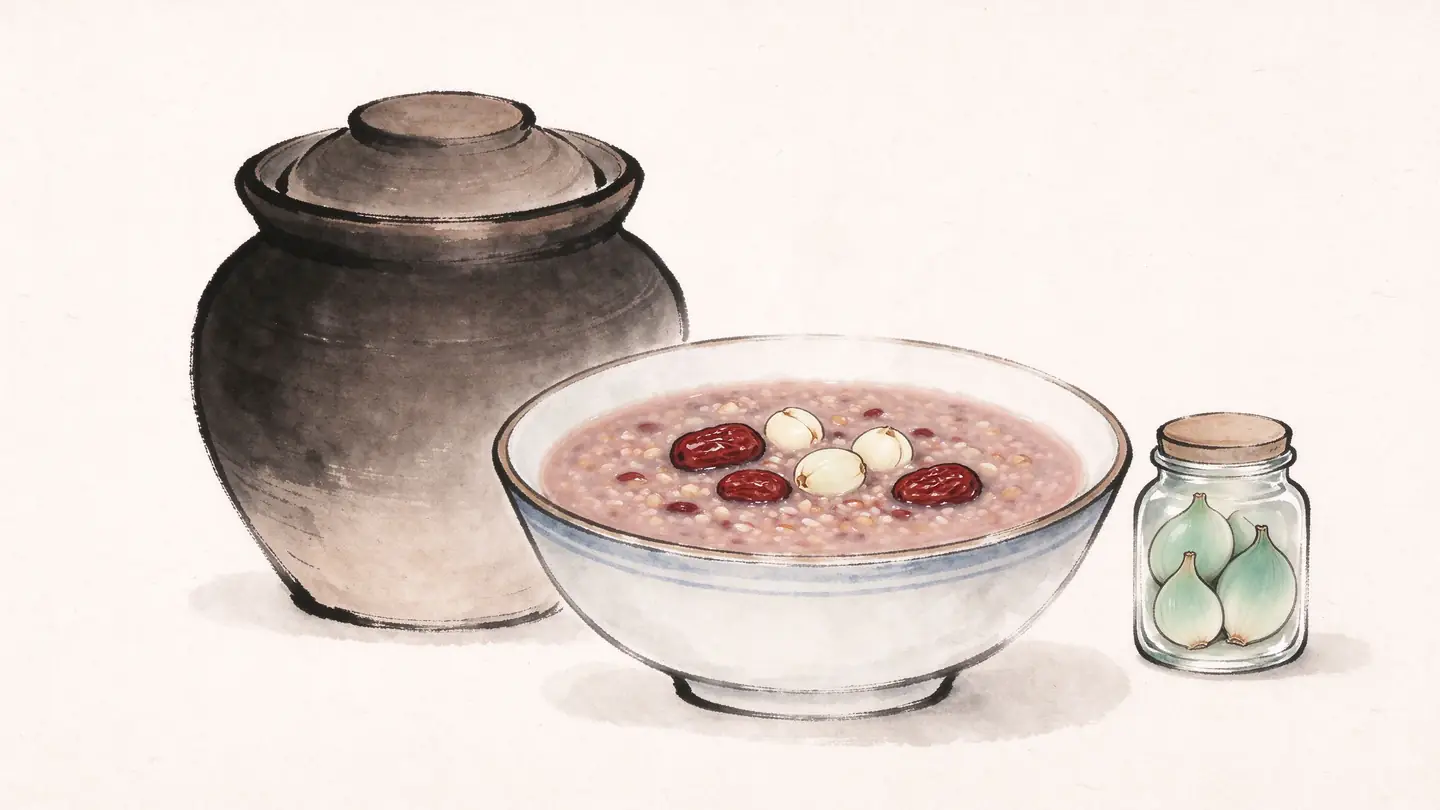
The story behind it Origin & legend
Laba has two origins that merged. The older one is the year-end sacrifice held in the twelfth lunar month, in which the harvest, the hunting catch and the ancestors were all given thanks.
The second is Buddhist. On the eighth day of the twelfth lunar month, Siddhartha Gautama is said to have awakened under the bodhi tree after years of extreme asceticism had brought him to the edge of death. A shepherd girl fed him milk rice, restoring his strength, and that night he attained enlightenment. Temples therefore cook and hand out congee on this day, and the festival is also called 佛成道节 — the Day of the Buddha's Enlightenment.
The result is a day that is simultaneously a harvest thanksgiving, a religious observance and, in practice, the starting pistol for Spring Festival preparations.
Modern Laba is chiefly a date on the calendar: from the eighth day of the twelfth month there are about three weeks to New Year. Congee ingredients are sold pre-mixed in supermarkets, temple kitchens still hand out thousands of free bowls, and northern families start their jar of garlic the same weekend, because it needs a full three weeks to turn green.
What it means Cultural significance
- The New Year starts here
- The real function of Laba in modern China is as a marker: from the eighth day of the twelfth month, there are about three weeks left. Shopping, cleaning and gift-buying all begin now.
- Thanksgiving for the whole harvest
- The porridge is the point of the ritual: eight or more grains, beans, nuts and dried fruits, one pot, everything the year produced. It is a harvest boiled down to a bowl.
- Charity as the original form
- Temples have distributed Laba congee to the poor for centuries, and they still do: long queues form at major temples in Hangzhou, Beijing and Shanghai every year, and the bowls are given free to anyone who waits.
- A festival of things beginning to end
- Laba is followed by Little New Year on the 23rd or 24th, then New Year's Eve. Laba is the first station on a three-week track that ends at the last night of the year.
- A first act of charity
- Handing a bowl of congee to a neighbour or a stranger is the oldest gesture of the day, older than the temple handout. It makes the festival social before it is religious, and it costs almost nothing.
- A day that belongs to several faiths at once
- Buddhist temples frame it as the Buddha's enlightenment; older households treat it as a harvest thanksgiving; modern families simply use it to start counting down. One bowl of porridge carries all three readings at the same time.
Hour by hour A day in the festival
- Before dawn · the pot goes on
- The congee needs hours, so it is started very early — often the night before, using beans and lotus seeds soaked since the previous day. In the north, the garlic is peeled around the same time.
- Early morning · congee for breakfast
- The first bowl is eaten at breakfast. A northern saying holds that eating it early brings an early harvest, so families try not to let the morning pass without it.
- Morning · a bowl handed to a neighbour
- Extra congee is carried to neighbours and, in the countryside, to the fields — a small offering left for the coming growing season as well as for people.
- Midday · temple queues
- At large temples free congee is handed out through the morning. Queues form before dawn in Hangzhou, Beijing and Shanghai, and some temples issue numbered tickets in advance.
- Afternoon · the countdown begins
- Cleaning, shopping and gift lists move into gear. Laba is the day families start planning the three weeks that run to New Year's Eve.
- Evening · the congee is kept
- A little is deliberately kept, so the pot never runs empty and the household starts the year with surplus rather than with nothing.
What people do Customs & activities
- Eating Laba congee (喝腊八粥)
- Rice, millet, glutinous rice, sorghum, red beans, mung beans, peanuts, lotus seeds, jujubes, chestnuts, longan and rock sugar — the list varies by family and region, and it is supposed to be eight or more.
- Pickling Laba garlic (腌腊八蒜)
- A northern custom: whole peeled garlic in vinegar, left until New Year's Eve, by which time the cloves have turned emerald green. They are eaten with dumplings that night.
- Temple congee distribution (施粥)
- Thousands of temples cook enormous pots and hand out bowls free to anyone who queues. Some cities issue numbered tickets before dawn, and the queues can run for hours.
- Making Laba tofu (晒腊八豆腐)
- In Anhui, blocks of tofu are salted, pressed and dried in the winter sun, then stored for cooking through the New Year season, sliced into soups or eaten cold with congee.
- Starting the New Year preparations
- Cleaning the house, buying new clothes, ordering speciality foods, and — formally — beginning the countdown that runs from here all the way to New Year's Eve.
- Counting down with a rhyme
- Northern children learn a chant that runs from the eighth day to the twenty-third of the month, roughly 'once Laba is past, the New Year is next'. It is a homemade calendar disguised as a rhyme.
- Making Laba noodles (吃腊八面)
- In parts of Shaanxi and the northwest, where wheat rather than rice is the staple, the day calls for a bowl of long noodles rather than a bowl of congee.
- Freezing a bowl for a forecast
- An older rural custom: a bowl of congee is left to freeze overnight, and the shape of the ice is read as a sign for the coming harvest — a rough folk weather forecast for the year ahead.
How it varies across China Regional differences
- North vs South: sweet or savoury
- Southern congee and temple congee are usually sweet, finished with rock sugar and dried fruit. Some northern households cook a savoury version with salt, vegetables and meat, so the same festival can taste completely different at two ends of the country.
- Rice congee vs wheat noodles
- Where rice grows, the day is about congee. In parts of Shaanxi and the northwest, where wheat is the staple, Laba means a bowl of long noodles instead — the date is shared, the staple is not.
- The garlic-only region
- Laba garlic is a strongly northern habit; families in the south often meet the day through congee alone. The green cloves are tied to the northern New Year dumpling table, which is where they get eaten.
- Which temple, which queue
- Temple distribution is heaviest in cities with famous temples, such as Hangzhou's Lingyin, Beijing's Yonghe and Shanghai's Jade Buddha. Elsewhere the day is quietly kept at home, and the long queues simply do not exist.
- Abroad: the day without the temples
- Overseas, Laba is mostly a home festival. Chinese groceries stock pre-mixed congee ingredients in the run-up, but there is no temple handout and no day off, so it is cooked on the nearest weekend.
What to say — and what not to Greetings
- Say: 腊八快乐
- There is no fixed phrase for Laba, so the plain 'happy Laba' (腊八快乐) is enough. Warmer still, mention the bowl: 'hope you get your Laba congee' — in Chinese, a nudge to 喝腊八粥, 'have your Laba porridge'.
- Say to a neighbour: here is your bowl
- The festival's real greeting is an action — handing over a bowl of congee with the words 腊八粥. It needs no formula; the gesture is the message, and it is the oldest thing about the day.
- To whom: elders, and anyone alone
- Send it to parents and grandparents first. Laba is also a good day to reach someone living alone, since the festival's second half is charity — a bowl and a message carry the same idea.
- Don't say: 腊八快乐 to a Buddhist friend if unsure
- For many Buddhists the day is a religious observance, 佛成道节, the Buddha's enlightenment. 腊八快乐 is not offensive, but 腊八安康 or a plain note about the porridge reads as more attentive to the occasion.
- If you have nothing fresh to say: keep it to the countdown
- The safest Laba message is simply about time: 'three weeks to New Year'. It is accurate, seasonal, and matches what the day actually means to most families today.
How to prepare Before the day
- Soak the beans the night before
- Red beans, mung beans and lotus seeds need at least eight hours or they will still be hard when the rice is done.
- Stock eight or more ingredients
- Check what you already have before you shop. The traditional count is not a shopping list, it is a principle — the more variety, the better the year.
- Start the garlic on the same day
- Laba garlic needs a full three weeks to turn green; if you start it later it will not be ready for New Year's Eve.
- Find a temple if you want the full experience
- In Hangzhou, Beijing, Shanghai and most provincial capitals, the queues start before dawn and can run for an hour or more. Go with a thermos, and expect to stand outside in the cold.
- Set out your New Year timeline
- Laba is the natural moment to write down when you will clean, shop, travel and send gifts. Three weeks is shorter than it sounds.
- Buy the ingredients before the rush
- Pre-mixed congee packets and single ingredients sell down in the days before the eighth. Shopping a few days early avoids finding the shelves picked over.
- Give the congee to a neighbour
- Cook more than the family can eat and hand a bowl over the wall. The oldest form of the day is sharing rather than eating, and it costs almost nothing to do.
What not to do Taboos
- Do not eat the congee after noon
- A common northern saying: eat it early, and the harvest comes early. Many families make sure it is on the table for breakfast.
- Do not throw the leftover congee away
- Leftovers are deliberate. The custom is to keep some, so that the pot never runs empty — the same logic as leaving fish on the table at New Year. It stands for surplus in the coming year.
- Do not lend money or settle debts today
- Laba sits at the start of the year-end accounting. Paying out on this day is believed to set the tone for a year of going out rather than coming in.
- Do not hold a wedding or move house on Laba
- Traditionally an inauspicious date for new beginnings, because the whole month is given over to closing the year, not starting things.
- Do not skip breakfast on this day
- Given the congee-before-noon custom, arriving at the day without having eaten it is the one way to genuinely miss the festival.
- Do not use a meat broth if you are serving observant guests
- The congee's Buddhist origin means the traditional version is vegan. Adding pork or chicken is common in some regions but will surprise a Buddhist guest.
- Do not rush the simmer
- The porridge needs hours on a low heat; beans, lotus seeds and nuts soften at different rates. Rushing it with high heat scorches the base and leaves the beans hard in the middle.
- Do not leave a bare metal pot unwatched
- The congee is thick and starchy and catches easily on a thin metal base. Traditional kitchens use a heavy clay or thick-bottomed pot and stir at the end.